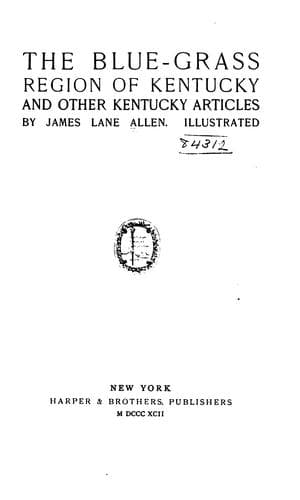
The Blue-Grass Region of Kentucky, and Other Kentucky Articles — John Shaqi
The Blue-Grass Region of Kentucky, and Other Kentucky ArticlesAllen, James Lane
General
The Blue-Grass Region of Kentucky, and Other Kentucky Articles
Allen, James Lane
Kentucky -- Description and travel; Kentucky -- Social life and customs
Among his negroes he finds a bad one. What shall he do with him? Keep
him? Keeping him makes him worse, and moreover he corrupts the
others. Set him free? That is to put a reward upon evil. Sell him to
his neighbors? They do not want him. If they did, he would not sell him
to them. He sells him into the South. This is a statement, not an
apology. Here, for a moment, one touches the terrible subject of the
internal slave-trade. Negroes were sold from Kentucky into the Southern
market because, as has just been said, they were bad, or by reason of
the law of partible inheritance, or, as was the case with Mrs. Stowe's
Uncle Tom, under constraint of debt. Of course, in many cases, they were
sold wantonly and cruelly; but these, however many, were not enough to
make the internal slave-trade more than an incidental and subordinate
feature of the system. The belief that negroes in Kentucky were
regularly bred and reared for the Southern market is a mistaken one.
Mrs. Stowe herself fell into the error of basing an argument for the
prevalence of the slave-trade in this State upon the notion of exhausted
lands, as the following passage from _The Key to Uncle Tom's Cabin_
shows:
[Illustration: THE COOK.]
"In Delaware, Maryland, Virginia, and Kentucky slave-labor long
ago impoverished the soil almost beyond recovery and became
entirely unprofitable."
Those words were written some thirty-five years ago and refer to a time
long prior to that date. Now, the fact is that at least one-half the
soil of Kentucky has never been under cultivation, and could not,
therefore, have been exhausted by slave-labor. At least a half of the
remainder, though cultivated ever since, is still not seriously
exhausted; and of the small portion still left a large share was always
naturally poor, so that for this reason slave-labor was but little
employed on it. The great slave-holding region of the State was the
fertile region which has never been impoverished. To return from this
digression, it may be well that the typical Kentucky farmer does not
find among his negroes a bad one; for in consequence of the early
non-importation of slaves for barter or sale, and through long
association with the household, they have been greatly elevated and
humanized. If he must sell a good one, he will seek a buyer among his
neighbors. He will even ask the negro to name his choice of a master and
try to consummate his wish. No purchaser near by, he will mount his
saddle-horse and look for one in the adjoining county. In this way the
negroes of different estates and neighborhoods were commonly connected
by kinship and intermarriage. How unjust to say that such a master did
not feel affection for his slaves, anxiety for their happiness, sympathy
with the evils inseparable from their condition. Let me cite the case of
a Kentucky master who had failed. He could pay his debts by sacrificing
his negroes or his farm, one or the other. To avoid separating the
Public-domain text, read in full here on John Shaqi.
Reviews
Reviews
No reviews yet
Be the first to share your thoughts on this work.
Join the Discussion
Join the discussion
Sign in to leave a comment or review.
Sign InorCreate an account