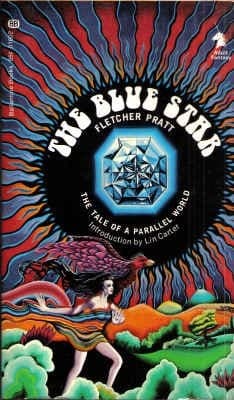
Fantasy fiction; Magic -- Fiction; Science fiction; Witches -- Fiction
“It seems to me,” said McCall, “that once you accept the idea of worlds
starting from approximately the same point—that is, another planet
having the same size and chemical makeup, and about the same distance
from its sun—”
“That’s what I find hard to accept,” said Hodge.
“Grant us our folly for a moment,” said McCall. “It leads to something
more interesting than chasing our tails.” He snapped his lighter. “What
I was saying is that if you grant approximately the same start, you’re
going to arrive at approximately the same end, in spite of what Penfield
thinks. We have evidence of that right on this earth. I mean what they
call convergent evolution. When the reptiles were dominant, they
produced vegetable-eaters and carnivores that fed on them. And among the
early mammals there were animals that looked so much like cats and
wolves that the only way to tell them apart is by the skeleton. Why
couldn’t that apply to human evolution, too?”
“You mean,” said Penfield, “that Beethoven and George Washington would
be inevitable?”
“Not that, exactly,” said McCall. “But some kind of musical inventor,
and some sort of high-principled military and political leader. There
might be differences.”
Hodge said: “Wait a minute. If we are the product of human history, so
were Beethoven and Washington. All you’ve got is a determinism, with
nothing really alterable, once the sun decided to cast off its planets.”
“The doctrine of free will—” began McCall.
“I know that one,” said Penfield. “But if you deny free will completely,
you’ll end up with a universe in which every world like ours is
identical—which is as absurd as Hodge’s picture of us is unique, and
rather more repulsive.”
“Well, then,” said Hodge, “What kind of cosmology are you putting out?
If you won’t have either of our pictures, give us yours.”
Penfield sipped port. “I can only suggest a sample,” he said. “Let’s
suppose this world—or one very like it—with one of those improbable
boiling-port accidents left out somewhere along the line. I mentioned
the wheel a moment ago. What would life be like now if it hadn’t been
invented?”
“Ask McCall,” said Hodge. “He’s the technician.”
“Not the wheel, no,” said McCall. “I can’t buy that. It’s too logical a
product of the environment. Happens as soon as a primitive man perceives
that a section of tree-trunk will roll. No. If you’re going to make a
supposition, you’ll have to keep it clean, and think in terms of
something that really might not have happened. For example, music. There
are lots of peoples, right here, who never found the full chromatic
scale, including the classical civilizations. But I suppose that’s not
basic enough for you.”
Public-domain text, read in full here on John Shaqi.
Reviews
Reviews
No reviews yet
Be the first to share your thoughts on this work.
Join the Discussion
Join the discussion
Sign in to leave a comment or review.
Sign InorCreate an account