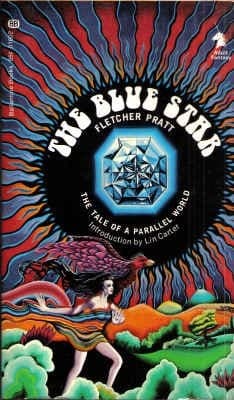
Fantasy fiction; Magic -- Fiction; Science fiction; Witches -- Fiction
“You’re being insular,” said Penfield. “I don’t mean that in another
world they would have turned psychology into an exact science in our
terms. It might be something altogether different. Your principles of
science are developed along the lines of arithmetic. The reason they
haven’t worked very well in dealing with the human mind may be because
they aren’t applicable at all. There may be quite a different line of
approach. Think it over for a moment. It might even be along the line of
magic, witchcraft.”
“I like that,” said McCall. “You want to make a difference by
substituting something phoney for something real.”
“But it might not be phoney,” insisted Penfield. “Magic and witchcraft
are really pretty late in our world. They began to be talked about at
the same time and on the same terms as alchemy, everything surrounded by
superstition, lying and plain ignorance. In this world we’re imagining,
somebody might have found the key to something as basic in that field as
gunpowder was to the physical sciences. Some people say we almost made
the discovery here. You know the story about this house?”
McCall nodded, but Hodge said: “No. What is it? Another ghost story?”
“Not quite. The old part of the house, the one where the bedrooms are
now, is supposed to have been built by one of the Salem witches. Not one
of those they hanged on false charges, but a perfectly genuine witch,
who got away before she was suspected—as a real witch probably would.
The story is that she came here and set up business among the Indians,
and as they weren’t very expert at carpentry, she helped them build that
part of the house with spells, so it would be eternal. The old beams
haven’t a bit of iron in them; they’re all held together with pegs and
haven’t rotted a bit. There’s also a story that if you make the proper
preparations at night, something beyond the normal will happen. I’ve
never done the right thing myself, apparently.”
“You probably won’t,” said Hodge. “The essence of the whole witchcraft
business is uncertainty. Haven’t you noticed that in all the legends,
the spells never quite come off when they’re needed?”
“That’s probably because there isn’t any science of witchcraft, with
predictable results,” said McCall.
Penfield said: “It may be for another reason, too. Have you ever noticed
that magic is the only form of human activity which is dominated by
women? The really scary creatures are all witches; when a man becomes a
magician, he’s either possessed of a devil or is a glorified juggler.
Our theoretical world would have to start by being a matriarchy.”
“Or contain the relics of one,” said Hodge. “Matriarchies are socially
unstable.”
“So is everything,” said McCall. “Flow and change from one form to
another is a characteristic of life—or maybe a definition of life. That
goes for your witchcraft, too. It would change form, there’d be
resistance to it, and an effort to find something to replace it.”
Public-domain text, read in full here on John Shaqi.
Reviews
Reviews
No reviews yet
Be the first to share your thoughts on this work.
Join the Discussion
Join the discussion
Sign in to leave a comment or review.
Sign InorCreate an account