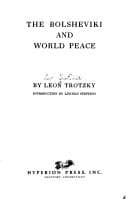
Communism -- Soviet Union; Europe -- Social conditions -- 20th century; Socialism; World War, 1914-1918
This book was written in extreme haste, under conditions far from
favorable to systematic work. A large part of it is devoted to the old
International which has fallen. But the entire book, from the first to
the last page, was written with the idea of the New International
constantly in mind, the New International which must rise up out of the
present world cataclysm, the International of the last conflict and the
final victory.
LEON TROTZKY.
THE BOLSHEVIKI AND WORLD PEACE
CHAPTER I
THE BALKAN QUESTION
"The War at present being waged against Russian Czarism and its
vassals is dominated by a great historic idea. The impetus of
this great historic idea consecrates the battlefields of Poland
and of Eastern Russia. The roar of cannon, the rattling of
machine guns, and the onrush of cavalry, all betoken the
enforcement of the democratic programme for the liberation of
the nations. Had Czarism, in league with the French
capitalistic powers and in league with an unscrupulous ’nation
of shopkeepers,’ not succeeded in suppressing the Revolution of
1905, the present slaughter of the nations would have been
avoided.
"A democratic Russia would never have consented to wage this
unscrupulous and futile War. The great ideas of freedom and
justice now speak the persuasive language of the machine gun and
the sword, and every heart susceptible of sympathy with justice
and humanity can only wish that the power of Czarism may be
destroyed once for all, and that the oppressed Russian
nationalities may again secure the right to decide their own
destinies."
The above quotation is from the _Nepszava_ of August 31, 1914, the
official organ of the Socialist party of Hungary. Hungary is the land
whose entire inner life was erected upon the high-handed oppression of
the national minorities, upon the enslavement of the laboring classes,
upon the official parasitism and usury of the ruling caste of large
landowners. It is the land in which men like Tisza are masters of the
situation, dyed-in-the-wool agrarians, with the manners of political
bandits. In a word, Hungary is a country closest of kin to Czar-ruled
Russia.
So what is more fitting than that the _Nepszava_, the Socialist organ of
Hungary, should hail with outbursts of enthusiasm the liberating mission
of the German and Austro-Hungarian armies? Who other than Count Tisza
could have felt the call to "enforce the democratic programme for the
liberation of the nations"? Who was there to uphold the eternal
principles of law and justice in Europe but the ruling clique of
Budapest, the discredited Panamists? Would you entrust this mission to
the unscrupulous diplomacy of "perfidious Albion," to the nation of
shopkeepers?
Public-domain text, read in full here on John Shaqi.
Reviews
Reviews
No reviews yet
Be the first to share your thoughts on this work.
Join the Discussion
Join the discussion
Sign in to leave a comment or review.
Sign InorCreate an account