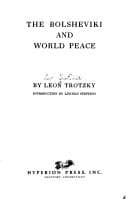
Communism -- Soviet Union; Europe -- Social conditions -- 20th century; Socialism; World War, 1914-1918
And Trotzky, in power, has been as red as he is in this book. The
minister of foreign affairs practised in Petrograd what he preached in
Switzerland, where he wrote most of the chapters of his book. And he
practised also what all the other great International Socialist leaders
talked and wrote.
That’s what makes him so hard to understand, him and his party and the
Bolshevik policy. We are accustomed to the sight of Socialists and
Radicals going into office and being "sobered by the responsibilities of
power." French and Italian Socialists in the Liberal ministries of
their countries; British Labor leaders in Parliament in England or in
the governments of their Colonies; and the whole Socialist party in
Germany and Austria (except Liebknecht in prison)--all are examples of
the effect of power upon the International Mind. The phenomenon of
compromise and surrender is so common that many radicals oppose the
taking of any responsible office by any member of their parties; and
some of the extremists are advocating no political action whatsoever,
nothing but industrial, economic or what they call "direct action."
(Our I.W.W.’s don’t vote, on principle.) This is anarchism.
Leon Trotzky is not an anarchist; except in the ignorant sense of the
word as used by educated people. He is a Socialist; an orthodox Marxian
Socialist. But he has seen vividly the danger of political power. The
body of this book was addressed originally to the German and Austrian
Socialists, and it is a reasoned, but indignant reproach of them for
letting their political position and their nationalistic loyalty carry
them away into an undemocratic, patriotic, political policy which
betrayed the weaker nations in their empires, helped break up the Second
(Socialist) International and led the Socialist parties into the support
of the War.
Clear upon it, Trotzky himself does not illustrate his own thesis. He
not only detests intellectually the secrecy and the sordid wickedness of
the "old diplomacy"; when he came as minister into possession of the
archives of the Russian Foreign Office, he published the secret
treaties.
That hurt. And so with the idea of a people’s peace. All the
democratic world had been talking ever since the war began of a peace
made, not by diplomats in a private room, but by the chosen
representatives of all the peoples meeting in an open congress. The
Bolsheviki worked for that from the moment the Russian Revolution broke;
and they labored for the Stockholm Conference while Paul Milyoukov and
Alexander Kerensky were negotiating with the allied governments. When
the Bolsheviki succeeded to power, Lenine and Trotzky formally
authorized and officially proposed such a congress. Moreover Trotzky
showed that they were willing, if they could, to force the other
countries to accept the people’s peace conference.
Public-domain text, read in full here on John Shaqi.
Reviews
Reviews
No reviews yet
Be the first to share your thoughts on this work.
Join the Discussion
Join the discussion
Sign in to leave a comment or review.
Sign InorCreate an account