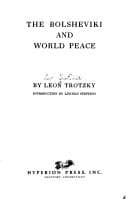
Communism -- Soviet Union; Europe -- Social conditions -- 20th century; Socialism; World War, 1914-1918
"The governments with their old-fashioned diplomacy," wrote Marx, "will
never solve the difficulty. Like the solution of so many other
problems, the Turkish problem, too, is reserved for the European
Revolution." This statement holds just as good to-day as when it was
first written. But for the Revolution to solve the difficulties that
have piled up in the course of centuries, the proletariat must have its
_own_ programme for the solution of the Austro-Hungarian question. And
this programme it must oppose just as strenuously to the Czaristic greed
of conquest as to the cowardly and conservative efforts to maintain the
Austro-Hungarian _status quo_.
CHAPTER II
AUSTRIA-HUNGARY
Russian Czarism undoubtedly represents a cruder and more barbarian form
of state organization than does the feebler absolutism of
Austria-Hungary, which has been mitigated by the weakness of old age.
But Russian Czarism and the Russian state are by no means identical.
The destruction of Czarism does not mean the disintegration of the
state. On the contrary it means its liberation and its strengthening.
All such assertions, as that it is necessary to push Russia back into
Asia, which found an echo even in certain Social Democratic organs, are
based on a poor knowledge of geography and ethnography. Whatever may be
the fate of various parts of present Russia--Russian Poland, Finland,
the Ukraine or Bessarabia--European Russia will not cease to exist as
the national territory of a many-millioned race that has made notable
conquests along the line of cultural development during the last quarter
century.
Quite different is the case of Austria-Hungary. As a state organization
it is identical with the Hapsburg Monarchy. It stands or falls with the
Hapsburgs, just as European Turkey was identical with the
feudal-military Ottoman caste and fell when that caste fell. A
conglomerate of racial fragments centrifugal in tendency, yet forced by
a dynasty to stick together, Austria-Hungary presents the most
reactionary picture in the very heart of Europe. Its continuation after
the present European catastrophe would not only delay the development of
the Danube and Balkan peoples for more decades to come and make a
repetition of the present War a practical certainty, but it would also
strengthen Czarism politically by preserving its main source of
spiritual nourishment.
Public-domain text, read in full here on John Shaqi.
Reviews
Reviews
No reviews yet
Be the first to share your thoughts on this work.
Join the Discussion
Join the discussion
Sign in to leave a comment or review.
Sign InorCreate an account