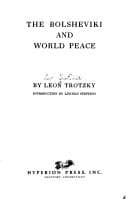
Communism -- Soviet Union; Europe -- Social conditions -- 20th century; Socialism; World War, 1914-1918
The defense of _German_ culture, _German_ soil, _German_ humanity seems
to be the mission not only of the German army but of the
Austro-Hungarian army as well. Serb must fight against Serb, Pole
against Pole, Ukranian against Ukranian, for the sake of "_German_
humanity." The forty million non-German nationalities of
Austria-Hungary are considered as simply historical manure for the field
of German culture. That this is not the standpoint of international
Socialism, it is not necessary to point out. It is not even pure
national democracy in its most elementary form. The Austro-Hungarian
General Staff explains this "humanity" in its communiqué of September
18th: "All peoples of our revered monarchy, as our military oath says,
’against any enemy no matter whom,’ must stand together as one, vying
with one another in courage."
The _Wiener Arbeiter-Zeitung_ accepts in its entirety this
Hapsburg-Hohenzollern viewpoint of the Austro-Hungarian problem as an
unnational military reservoir. It is the same attitude as the
militarists of France have toward the Senegalese and the Moroccans, and
the English have toward the Hindus. And when we consider that such
opinions are not a new phenomenon among the German Socialists of
Austria, we have found the main reason why the Austrian Social Democracy
broke up so miserably into national groups, and thus reduced its
political importance to a minimum.
The disintegration of the Austrian Social Democracy into national parts
fighting among themselves, is one expression of the inadequacy of
Austria as a state organization. At the same time the attitude of the
German-Austrian Social Democracy proved that it was itself the sorry
victim of this inadequacy, to which it capitulated spiritually. When it
proved itself impotent to unite the many-raced Austrian proletariat
under the principles of Internationalism, and finally gave up this task
altogether, the Austro-German Social Democracy subordinated all
Austria-Hungary and even its own policies to the "Idea" of Prussian
Junker Nationalism. This utter denial of principles speaks to us in an
unprecedented manner from the pages of the _Wiener Arbeiter-Zeitung_.
But if we listen more carefully to the tones of this hysterical
nationalism we cannot fail to hear a graver voice, the voice of history
telling us that the path of political progress for Central and
Southeastern Europe leads over the ruins of the Austro-Hungarian
Monarchy.
CHAPTER III
THE WAR AGAINST CZARISM
But how about Czarism? Would not Germany’s and Austria’s victory mean
the defeat of Czarism? And would not the beneficent results of the
defeat of Czarism greatly outbalance the beneficent results of a
dismembered Austria-Hungary?
Public-domain text, read in full here on John Shaqi.
Reviews
Reviews
No reviews yet
Be the first to share your thoughts on this work.
Join the Discussion
Join the discussion
Sign in to leave a comment or review.
Sign InorCreate an account