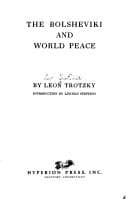
Communism -- Soviet Union; Europe -- Social conditions -- 20th century; Socialism; World War, 1914-1918
The German Social Democracy by its present policy smooths the way for
this awful danger. And the danger will become an actuality unless the
European proletariat interferes and enters as a revolutionary factor
into the plans of the dynasties and the capitalistic governments.
CHAPTER IV
THE WAR AGAINST THE WEST
On his return from his diplomatic trip to Italy, Dr. Südekum wrote in
the _Vorwärts_ that the Italian comrades did not sufficiently comprehend
the nature of Czarism. We agree with Dr. Südekum that a German can more
easily understand the nature of Czarism as he experiences daily, in his
own person, the nature of Prussian-German absolutism. The two "natures"
are very closely akin to each other.
German absolutism represents a feudal-monarchical organization, resting
upon a mighty capitalist foundation, which the development of the last
half-century has erected for it. The strength of the German army, as we
have learned to know it anew in its present bloody work, consists not
alone in the great material and technical resources of the nation, and
in the intelligence and precision of the workman-soldier, who had been
drilled in the school of industry and his own class organizations. It
has its foundation also in its Junker officer caste, with its master
class traditions, its oppression of those who are below and its
subordination to those who are above. The German army, like the German
state, is a feudal-monarchical organization with inexhaustible
capitalistic resources. The bourgeois scribblers may chatter all they
want about the supremacy of the German, the man of duty, over the
Frenchman, the man of pleasure; the real difference lies not in the
racial qualities, but in the social and political conditions. The
standing army, that closed corporation, that self-sufficing state within
the state, remains, despite universal military service, a caste
organization that in order to thrive must have artificial distinctions
of rank and a monarchical top to crown the commanding hierarchy.
In his work, "The New Army," Jaurès showed that the only army France
could have is an army of defense built on the plan of arming every
citizen, that is, a democratic army, a _militia_. The bourgeois French
Republic is now paying the penalty for having made her army a
counterpoise to her democratic state organization. She created, in
Jaurès’ words, "a bastard régime in which antiquated forms clashed with
newly developing forms and neutralized each other." This incongruity
between the standing army and the republican régime is the fundamental
weakness of the French military system.
Public-domain text, read in full here on John Shaqi.
Reviews
Reviews
No reviews yet
Be the first to share your thoughts on this work.
Join the Discussion
Join the discussion
Sign in to leave a comment or review.
Sign InorCreate an account