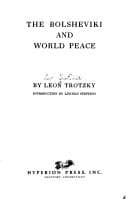
Communism -- Soviet Union; Europe -- Social conditions -- 20th century; Socialism; World War, 1914-1918
"Nevertheless, a revolutionary government, if it comes soon,
need not despair. But it must leave Paris to its fate, and
continue to carry on the war from the south. It is then still
possible that such a government may hold out until arms and
ammunition are bought and a new army organized with which the
enemy can be gradually pushed back to the frontier. That would
be the right ending to the war--for both countries to
demonstrate that they cannot be conquered."
And yet there are people who shout like drunken helots, "On to Paris."
And in doing so they have the impudence to invoke the names of Marx and
Engels. In what measure are they superior to the thrice despised
Russian liberals who crawled on their bellies before his Excellency, the
military Commander, who introduced the Russian knout into East Galicia.
It is cowardly arrogance--this talk of the purely "strategic" character
of the War on the Western front. Who takes any account of it? Certainly
not the German ruling classes. They speak the language of conviction
and of main force. They call things by their right names. They know
what they want and they know how to fight for it.
The Social Democrats tell us that the War is being waged for the cause
of national independence. "That is not true," retorted Herr Arthur Dix.
"Just as the high politics of the last century," wrote Dix,
"owed its specially marked character to the _National Idea_, so
the political-world events of this century stand under the
emblem of the _Imperialistic Idea_. The imperialistic idea that
is destined to give the impetus, the scope and the goal to the
striving for power of the great (_Der Weltwirtschaftskrieg_,
1914, p. 3).
"It shows gratifying sagacity," says the same Herr Arthur Dix,
"on the part of those who had charge of the military
preparations of the War, that the advance of our armies against
France and Russia in the very first stage of the War took place
precisely where it was most important to keep valuable German
mineral wealth free from foreign invasion, and to occupy such
portions of the enemy’s territory as would supplement our own
underground resources" (Ibid., p. 38).
The "strategy," of which the Socialists now speak in devout whispers,
really begins its activities with the robbery of mineral wealth.
The Social Democrats tell us that the War is a war of defense. But Herr
Georg Irmer says clearly and distinctly:
"People ought not to be talking as though the German nation had
come too late for rivalry for world economy and world
dominion,--that the world has already been divided. Has not the
earth been divided over and over again in all epochs of
history?" (_Los vom englischen Weltjoch_, 1914, p. 42.)
Public-domain text, read in full here on John Shaqi.
Reviews
Reviews
No reviews yet
Be the first to share your thoughts on this work.
Join the Discussion
Join the discussion
Sign in to leave a comment or review.
Sign InorCreate an account