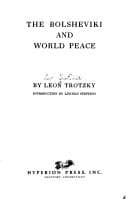
Communism -- Soviet Union; Europe -- Social conditions -- 20th century; Socialism; World War, 1914-1918
The bourgeois politicians and professors tell us that England is the
chief enemy; that Belgium and France are the gateway to the Atlantic
Ocean; that the hope of a Russian indemnity is only a Utopian dream,
anyway; that Russia would be more useful as friend than as foe; that
France will have to pay in land and in gold--and the _Vorwärts_ exhorts
the German workers to "hold out until the decisive victory is ours."
And yet the _Vorwärts_ tells us that the War is being waged for the
independence of the German nation, and for the liberation of the Russian
people. What does this mean? Of course we must not look for ideas,
logic and truth where they do not exist. This is simply a case of an
ulcer of slavish sentiments bursting open and foul pus crawling over the
pages of the workingmen’s press. It is clear that the oppressed class
which proceeds too slowly and inertly on its way toward freedom must in
the final hour drag all its hopes and promises through mire and blood,
before there arises in its soul the pure, unimpeachable voice--the voice
of revolutionary honor.
CHAPTER V
THE WAR OF DEFENSE
"The thing for us to do now is to avert this danger [Russian
despotism], and to secure the culture and the independence of
our land. Thus we will make good our word, and do what we have
always said we would. In the hour of danger we will not leave
our Fatherland in the lurch.... Guided by these principles we
vote for the war credits."
This was the declaration of the German Social Democratic fraction, read
by Haase in the Reichstag session of August 4.
Here only the defense of the fatherland is mentioned. Not a word is
said of the "liberating" mission of this War in behalf of the peoples of
Russia, which was later sung in every key by the Social Democratic
press. The logic of the Socialist press, however, did not keep pace
with its patriotism. For while it made desperate efforts to represent
the War as one of pure defense, to secure the safety of Germany’s
possessions, it at the same time pictured it as a revolutionary
offensive war for the liberation of Russia and of Europe from Czarism.
We have already shown clearly enough why the peoples of Russia had every
reason to decline with thanks the assistance offered them at the point
of the Hohenzollern bayonets. But how about the "defensive" character of
the War?
Public-domain text, read in full here on John Shaqi.
Reviews
Reviews
No reviews yet
Be the first to share your thoughts on this work.
Join the Discussion
Join the discussion
Sign in to leave a comment or review.
Sign InorCreate an account