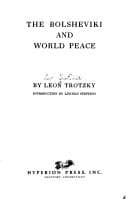
Communism -- Soviet Union; Europe -- Social conditions -- 20th century; Socialism; World War, 1914-1918
Germany opened her "Defensive War" with an attack upon Belgium, the
violation of Belgium’s neutrality being allegedly only a means of
breaking through to France along the line of least resistance. The
military defeat of France also was to appear only as a strategic episode
in the defense of the Fatherland.
To some German patriots this construction of things did not seem quite
plausible, and they had good grounds for disbelieving it. They suspected
a motive which squared far better with the reality. Russia, entering
upon a new era of military preparation, would be a far greater menace to
Germany in two or three years than she was then. And France during that
time would have completely carried out her three-year army reform. Is
it not clear, then, that an intelligent self-defense demanded that
Germany should not wait for the attack of her enemies but should
anticipate them by two years and take the offensive at once? And isn’t
it clear, too, that such an offensive war, deliberately provoked by
Germany and Austria, is in reality a preventive war of defense?
Not infrequently these two points of view are combined in a single
argument. Granted that there is some slight contradiction between them.
The one declares that Germany did not want the War now and that it was
forced upon her by the Triple Entente, while the other implies that war
was disadvantageous to the Entente now and that for that very reason
Germany had taken the initiative to bring on the War at this time. But
what if there is this contradiction? It is lightly and easily glossed
over and reconciled in the saving concept of a war of defense.
But the belligerents on the other side disputed this advantageous
position of being on the defensive, which Germany sought to assume, and
did it successfully. France could not permit the defeat of Russia on
the ground of her own self-defense. England gave as the motive for her
interference the immediate danger to the British Islands which a
strengthening of Germany’s position at the mouth of the Channel would
mean. Finally, Russia, too, spoke only of self-defense. It is true
that no one threatened Russian territory. But national possessions,
mark you, do not consist merely in territory, but in other, intangible,
factors as well, among them, the influence over weaker states. Servia
"belongs" in the sphere of Russian influence and serves the purpose of
maintaining the so-called balance of power in the Balkans, not only the
balance of power between the Balkan States but also between Russian and
Austrian influence. A successful Austrian attack on Servia threatened
to disturb this balance of power in Austria’s favor, and therefore meant
an indirect attack upon Russia. Sasonov undoubtedly found his strongest
argument in Quessel’s words: "It would be senseless to believe that one
wall could be torn away from the extremely complex structure (Europe)
without endangering the security of the entire edifice."
Public-domain text, read in full here on John Shaqi.
Reviews
Reviews
No reviews yet
Be the first to share your thoughts on this work.
Join the Discussion
Join the discussion
Sign in to leave a comment or review.
Sign InorCreate an account