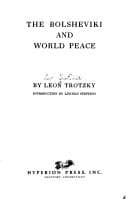
Communism -- Soviet Union; Europe -- Social conditions -- 20th century; Socialism; World War, 1914-1918
"In my opinion we cannot promise positively to share the
government’s war enthusiasm every time we are convinced that the
country is threatened by attack. Bebel thinks we are much
further advanced than we were in 1870 and that we are now able
to decide in every instance whether the war which threatens is
really one of aggression or not. I should not like to take this
responsibility upon myself. I should not like to undertake to
guarantee that we could make a correct decision in every
instance, that we shall always know whether a government is
deceiving us, or whether it is not actually representing the
interests of the nation against a war of attack.... Yesterday
it was the German government that took the aggressive, to-morrow
it will be the French government, and we cannot know if the day
after it may not be the English government. The governments are
constantly taking turns. As a matter of fact what we are
concerned with in case of war is not a national, but an
international question. For a war between great powers will
become a world war and will affect the whole of Europe, not two
countries alone. Some day the German government might make the
German proletariat believe they were being attacked; the French
government might do the same with its subjects, and then we
should have a war in which the French and German working men
would follow their respective governments with equal enthusiasm,
and murder each other and cut each other’s throats. Such a
contingency must be avoided, and it will be avoided if we do not
adopt the criterion of the aggressive or defensive war, but that
of the interests of the proletariat, which at the same time are
international interests.... Fortunately, it is a misconception
to assume that the German Social Democracy in case of war wanted
to judge by national and not by international considerations,
and felt itself to be first a German and then a proletariat
party."
With splendid clearness Kautsky in this speech reveals the terrible
dangers--now a still more terrible actuality--that are latent in the
endeavor to make the position of the Social Democracy dependent upon an
indefinite and contradictory formal estimate of whether a war is one of
defense or one of aggression. Bebel in his reply said nothing of
importance; and his point of view seemed quite inexplicable, especially
after his own experiences of the year 1870.
Nevertheless, in spite of its theoretical inadequacy, Bebel’s position
had a quite definite political meaning. Those imperialistic tendencies
which the danger of war begat excluded the possibility for the Social
Democracy’s expecting salvation from the victory of either of the
warring parties. For that very reason its entire attention was directed
to the preventing of war, and the principal task was to keep the
governments worried about the results of a war.
Public-domain text, read in full here on John Shaqi.
Reviews
Reviews
No reviews yet
Be the first to share your thoughts on this work.
Join the Discussion
Join the discussion
Sign in to leave a comment or review.
Sign InorCreate an account