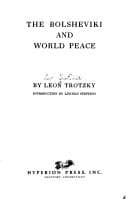
Communism -- Soviet Union; Europe -- Social conditions -- 20th century; Socialism; World War, 1914-1918
The proletariat had an equal economic interest in the democratizing and
the cultural progress of all other countries in their relation of buyer
or seller to its own country. In this resided the most important
guarantee for the international solidarity of the proletariat both in so
far as final aims and daily policies are concerned. The struggle
against the remnants of feudal barbarism, against the boundless demands
of militarism, against agrarian duties and indirect taxes was the main
object of working-class politics and served, directly and indirectly, to
help develop the forces of production. That is the very reason why the
great majority of organized labor joined political forces with the
Social Democracy. Every hindrance to the development of the forces of
production touches the trade unions most closely.
As capitalism passed from a national to an international-imperialistic
ground, national production, and with it the economic struggle of the
proletariat, came into direct dependence on those conditions of the
world-market which are secured by dreadnaughts and cannon. In other
words, in contradiction of the fundamental interests of the proletariat
taken in their wide historic extent, the immediate trade interests of
various strata of the proletariat proved to have a direct dependence
upon the successes or the failures of the foreign policies of the
governments.
England long before the other countries placed her capitalistic
development on the basis of predatory imperialism, and she interested
the upper strata of the proletariat in her world dominion. In
championing its own class interests, the English proletariat limited
itself to exercising pressure on the bourgeois parties which granted it
a share in the capitalistic exploitation of other countries. It did not
begin an independent policy until England began to lose her position in
the world market, pushed aside, among others, by her main rival,
Germany.
But with Germany’s growth to industrial world-importance, grew the
dependence of broad strata of the German proletariat on German
imperialism, not materially alone but also ideally. The _Vorwärts_
wrote on August 11th that the German workingmen, "counted among the
politically intelligent, to whom we have preached the dangers of
imperialism for years (although _with very little success_, we must
confess)" scold at Italian neutrality like the extremest chauvinists.
But that did not prevent the _Vorwärts_ from feeding the German
workingmen on "national" and "democratic" arguments in justification of
the bloody work of imperialism. (Some writers’ backbones are as
flexible as their pens.)
Public-domain text, read in full here on John Shaqi.
Reviews
Reviews
No reviews yet
Be the first to share your thoughts on this work.
Elsewhere in the archive
Join the Discussion
Join the discussion
Sign in to leave a comment or review.
Sign InorCreate an account