Man-woman relationships -- Fiction; Race relations -- Fiction; United States -- History -- Civil War, 1861-1865 -- Fiction
Produced by Roger Frank and the Online Distributed
Proofreading Team at https://www.pgdp.net
[Illustration: "I give you back the wedding ring."--_Page 400._]
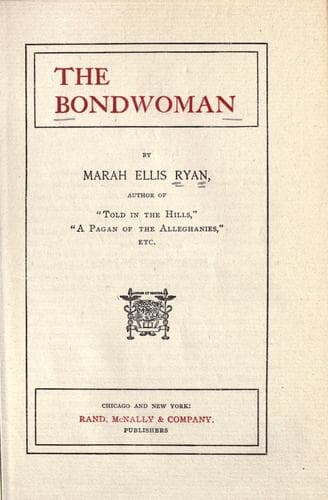
THE BONDWOMAN
BY
MARAH ELLIS RYAN,
AUTHOR OF
"Told in the Hills," "A Pagan of the Alleghanies," etc.
CHICAGO AND NEW YORK:
RAND, McNALLY & COMPANY, PUBLISHERS.
MDCCCXCIX.
Copyright, 1899, by Rand, McNally & Co.
All rights reserved.
Entered at Stationers' Hall, London.
THE BONDWOMAN
CHAPTER I.
Near Moret, in France, where the Seine is formed and flows northward,
there lives an old lady named Madame Blanc, who can tell much of the
history written here--though it be a history belonging more to
American lives than French. She was of the Caron establishment when
Judithe first came into the family, and has charge of a home for aged
ladies of education and refinement whose means will not allow of them
providing for themselves. It is a memorial founded by her adopted
daughter and is known as the Levigne Pension. The property on which it
is established is the little Levigne estate--the one forming the only
dowery of Judithe Levigne when she married Philip Alain--Marquis de
Caron.
There is also a bright-eyed, still handsome woman of mature years,
who lives in our South and has charge of another memorial--or had
until recently--a private industrial school for girls of her own
selection. She calls herself a creole of San Domingo, and she also
calls herself Madame Trouvelot--she has been married twice since
she was first known by that name, for she was never the woman to live
alone--not she; but while the men in themselves suited her, their
names were uncompromisingly plain--did not attract her at all. She
married them, proved a very good wife, but while one was named
Johnson, and another Tuttle, the good wife persisted in being
called Madame Trouvelot, either through sentiment or a bit of irony
towards the owner of that name. But, despite her vanities, her
coquetries, and certain erratic phases of her life, she was
absolutely faithful to the trust reposed in her by the Marquise; and
who so capable as herself of finding the poor girls who stood most
in need of training and the shelter of charity? She, also, could
add to this history of the woman belonging both to the old world
and the new. There are also official records in evidence of much
that is told here--deeds of land, bills of sale, with dates of
marriages and deaths interwoven, changed as to names and places but--
There are social friends--gay, pleasure-loving people on both sides of
the water--who could speak, and some men who will never forget her.
Public-domain text, read in full here on John Shaqi.
Reviews
Reviews
No reviews yet
Be the first to share your thoughts on this work.
Join the Discussion
Join the discussion
Sign in to leave a comment or review.
Sign InorCreate an account