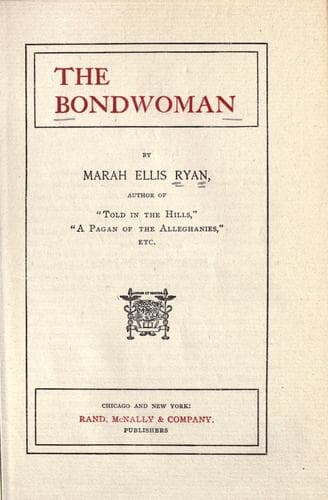
Man-woman relationships -- Fiction; Race relations -- Fiction; United States -- History -- Civil War, 1861-1865 -- Fiction
Then she sent some kindly message to Mrs. McVeigh, but refused to see
the wonder--the actual pain--in the eyes where before she had
remembered those half slumberous smiles, or that brief space of
passionate pleading. He interrupted some cool remark by rising.
"It is scarcely worth while--all this," he said, abruptly. "Had you
closed your doors against me after last night I should have
understood--I should have gone away adoring you just the same. But to
open them, to receive me, and then--"
His voice trembled in spite of himself. All at once he appeared so
much more boyish than ever before--so helpless in a sort of misery he
could not account for, she turned away her head.
"With the ocean between us my love could not have hurt you. You might
have let me keep that." He had recovered control of his voice and his
eyes swept over her from head to foot like blue lightning. "I bid you
good-day, Madame."
She made an inclination of the head, but did not speak. She had
reached the limit of her self control. His words, "_You might have let
me keep that_," were an accusation she dared not discuss.
When the door closed behind him she could see nothing, for the blur of
tears in her eyes. Madame La Marquise received no other callers that
day.
In the days following she compared him with the courtiers, the
diplomats, the very clever men whom she met, and told herself he was
only a boy--a cadet of twenty-two. Why should she remember his words,
or forget for one instant that infamy with which his name was
connected?
"He goes on his knees to me only because he has grown weary of the
slave-women of the plantations," she told herself in deepest disgust.
Sometimes she would look curiously at the hands once covered by his
kisses. And once she threw a withered bunch of forget-me-nots from her
window, at night, and crept down at daybreak next morning and found
it, and took it back to her room.
It looked as though the boy was holding his own despite the
diplomats.
When she saw him again it was at an auction of articles donated for a
charity under the patronage of the Empress, and open to the public.
Cotton stuffs justled my lady's satins, and the half-world stared at
short range into the faces whose owners claimed coronets.
Many leading artists had donated sketches of their more pretentious
work. It was to that department the Marquise made her way, and
entering the gallery by a side door, found that the crowd had
separated her from the Countess Biron and the rest of their party.
Public-domain text, read in full here on John Shaqi.
Reviews
Reviews
No reviews yet
Be the first to share your thoughts on this work.
Join the Discussion
Join the discussion
Sign in to leave a comment or review.
Sign InorCreate an account