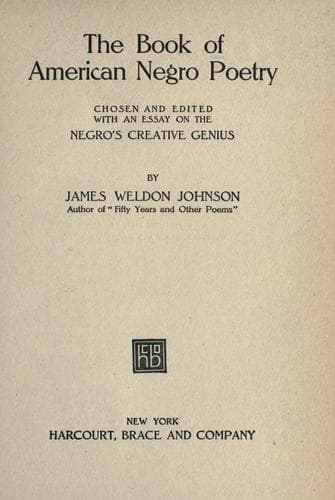
African Americans -- Poetry; American poetry -- African American authors
According to "A Bibliographical Checklist of American Negro Poetry,"
compiled by Mr. Arthur A. Schomburg, more than one hundred Negroes in the
United States have published volumes of poetry ranging in size from
pamphlets to books of from one hundred to three hundred pages. About
thirty of these writers fill in the gap between Phillis Wheatley and Paul
Laurence Dunbar. Just here it is of interest to note that a Negro wrote
and published a poem before Phillis Wheatley arrived in this country from
Africa. He was Jupiter Hammon, a slave belonging to a Mr. Lloyd of
Queens-Village, Long Island. In 1760 Hammon published a poem, eighty-eight
lines in length, entitled "An Evening Thought, Salvation by Christ, with
Penettential Cries." In 1788 he published "An Address to Miss Phillis
Wheatley, Ethiopian Poetess in Boston, who came from Africa at eight years
of age, and soon became acquainted with the Gospel of Jesus Christ." These
two poems do not include all that Hammon wrote.
The poets between Phillis Wheatley and Dunbar must be considered more in
the light of what they attempted than of what they accomplished. Many of
them showed marked talent, but barely a half dozen of them demonstrated
even mediocre mastery of technique in the use of poetic material and
forms. And yet there are several names that deserve mention. George M.
Horton, Frances E. Harper, James M. Bell and Alberry A. Whitman, all merit
consideration when due allowances are made for their limitations in
education, training and general culture. The limitations of Horton were
greater than those of either of the others; he was born a slave in North
Carolina in 1797, and as a young man began to compose poetry without being
able to write it down. Later he received some instruction from professors
of the University of North Carolina, at which institution he was employed
as a janitor. He published a volume of poems, "The Hope of Liberty," in
1829.
Mrs. Harper, Bell and Whitman would stand out if only for the reason that
each of them attempted sustained work. Mrs. Harper published her first
volume of poems in 1854, but later she published "Moses, a Story of the
Nile," a poem which ran to 52 closely printed pages. Bell in 1864
published a poem of 28 pages in celebration of President Lincoln's
Emancipation Proclamation. In 1870 he published a poem of 32 pages in
celebration of the ratification of the Fifteenth Amendment to the
Constitution. Whitman published his first volume of poems, a book of 253
pages, in 1877; but in 1884 he published "The Rape of Florida," an epic
poem written in four cantos and done in the Spenserian stanza, and which
ran to 97 closely printed pages. The poetry of both Mrs. Harper and of
Whitman had a large degree of popularity; one of Mrs. Harper's books went
through more than twenty editions.
Public-domain text, read in full here on John Shaqi.
Reviews
Reviews
No reviews yet
Be the first to share your thoughts on this work.
Join the Discussion
Join the discussion
Sign in to leave a comment or review.
Sign InorCreate an account