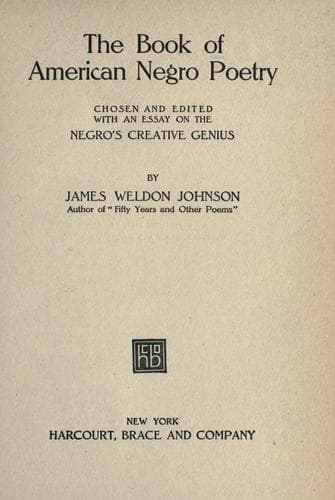
African Americans -- Poetry; American poetry -- African American authors
Paul Laurence Dunbar stands out as the first poet from the Negro race in
the United States to show a combined mastery over poetic material and
poetic technique, to reveal innate literary distinction in what he wrote,
and to maintain a high level of performance. He was the first to rise to a
height from which he could take a perspective view of his own race. He was
the first to see objectively its humor, its superstitions, its
shortcomings; the first to feel sympathetically its heart-wounds, its
yearnings, its aspirations, and to voice them all in a purely literary
form.
Dunbar's fame rests chiefly on his poems in Negro dialect. This appraisal
of him is, no doubt, fair; for in these dialect poems he not only carried
his art to the highest point of perfection, but he made a contribution to
American literature unlike what any one else had made, a contribution
which, perhaps, no one else could have made. Of course, Negro dialect
poetry was written before Dunbar wrote, most of it by white writers; but
the fact stands out that Dunbar was the first to use it as a medium for
the true interpretation of Negro character and psychology. And, yet,
dialect poetry does not constitute the whole or even the bulk of Dunbar's
work. In addition to a large number of poems of a very high order done in
literary English, he was the author of four novels and several volumes of
short stories.
Indeed, Dunbar did not begin his career as a writer of dialect. I may be
pardoned for introducing here a bit of reminiscence. My personal
friendship with Paul Dunbar began before he had achieved recognition, and
continued to be close until his death. When I first met him he had
published a thin volume, "Oak and Ivy," which was being sold chiefly
through his own efforts. "Oak and Ivy" showed no distinctive Negro
influence, but rather the influence of James Whitcomb Riley. At this time
Paul and I were together every day for several months. He talked to me a
great deal about his hopes and ambitions. In these talks he revealed that
he had reached a realization of the possibilities of poetry in the
dialect, together with a recognition of the fact that it offered the
surest way by which he could get a hearing. Often he said to me: "I've
got to write dialect poetry; it's the only way I can get them to listen
to me." I was with Dunbar at the beginning of what proved to be his last
illness. He said to me then: "I have not grown. I am writing the same
things I wrote ten years ago, and am writing them no better." His
self-accusation was not fully true; he had grown, and he had gained a
surer control of his art, but he had not accomplished the greater things
of which he was constantly dreaming; the public had held him to the things
for which it had accorded him recognition. If Dunbar had lived he would
have achieved some of those dreams, but even while he talked so dejectedly
to me he seemed to feel that he was not to live. He died when he was only
thirty-three.
Public-domain text, read in full here on John Shaqi.
Reviews
Reviews
No reviews yet
Be the first to share your thoughts on this work.
Join the Discussion
Join the discussion
Sign in to leave a comment or review.
Sign InorCreate an account