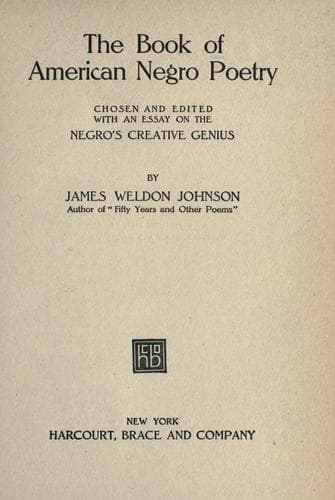
African Americans -- Poetry; American poetry -- African American authors
It may be surprising to many to see how little of the poetry being written
by Negro poets to-day is being written in Negro dialect. The newer Negro
poets show a tendency to discard dialect; much of the subject-matter which
went into the making of traditional dialect poetry, 'possums, watermelons,
etc., they have discarded altogether, at least, as poetic material. This
tendency will, no doubt, be regretted by the majority of white readers;
and, indeed, it would be a distinct loss if the American Negro poets threw
away this quaint and musical folk-speech as a medium of expression. And
yet, after all, these poets are working through a problem not realized by
the reader, and, perhaps, by many of these poets themselves not realized
consciously. They are trying to break away from, not Negro dialect itself,
but the limitations on Negro dialect imposed by the fixing effects of long
convention.
The Negro in the United States has achieved or been placed in a certain
artistic niche. When he is thought of artistically, it is as a
happy-go-lucky, singing, shuffling, banjo-picking being or as a more or
less pathetic figure. The picture of him is in a log cabin amid fields of
cotton or along the levees. Negro dialect is naturally and by long
association the exact instrument for voicing this phase of Negro life; and
by that very exactness it is an instrument with but two full stops, humor
and pathos. So even when he confines himself to purely racial themes, the
Aframerican poet realizes that there are phases of Negro life in the
United States which cannot be treated in the dialect either adequately or
artistically. Take, for example, the phases rising out of life in Harlem,
that most wonderful Negro city in the world. I do not deny that a Negro in
a log cabin is more picturesque than a Negro in a Harlem flat, but the
Negro in the Harlem flat is here, and he is but part of a group growing
everywhere in the country, a group whose ideals are becoming increasingly
more vital than those of the traditionally artistic group, even if its
members are less picturesque.
What the colored poet in the United States needs to do is something like
what Synge did for the Irish; he needs to find a form that will express
the racial spirit by symbols from within rather than by symbols from
without, such as the mere mutilation of English spelling and
pronunciation. He needs a form that is freer and larger than dialect, but
which will still hold the racial flavor; a form expressing the imagery,
the idioms, the peculiar turns of thought, and the distinctive humor and
pathos, too, of the Negro, but which will also be capable of voicing the
deepest and highest emotions and aspirations, and allow of the widest
range of subjects and the widest scope of treatment.
Public-domain text, read in full here on John Shaqi.
Reviews
Reviews
No reviews yet
Be the first to share your thoughts on this work.
Join the Discussion
Join the discussion
Sign in to leave a comment or review.
Sign InorCreate an account