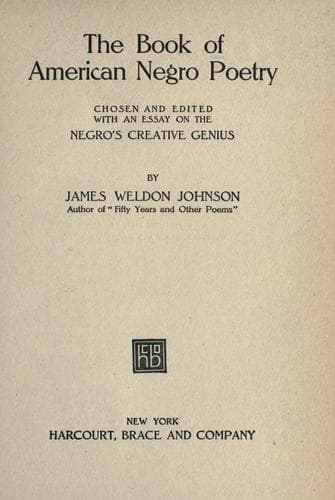
African Americans -- Poetry; American poetry -- African American authors
But the group of the new Negro poets, whose work makes up the bulk of this
anthology, contains names destined to be known. Claude McKay, although
still quite a young man, has already demonstrated his power, breadth and
skill as a poet. Mr. McKay's breadth is as essential a part of his
equipment as his power and skill. He demonstrates mastery of the three
when as a Negro poet he pours out the bitterness and rebellion in his
heart in those two sonnet-tragedies, "If We Must Die" and "To the White
Fiends," in a manner that strikes terror; and when as a cosmic poet he
creates the atmosphere and mood of poetic beauty in the absolute, as he
does in "Spring in New Hampshire" and "The Harlem Dancer." Mr. McKay gives
evidence that he has passed beyond the danger which threatens many of the
new Negro poets--the danger of allowing the purely polemical phases of the
race problem to choke their sense of artistry.
Mr. McKay's earliest work is unknown in this country. It consists of poems
written and published in his native Jamaica. I was fortunate enough to run
across this first volume, and I could not refrain from reproducing here
one of the poems written in the West Indian Negro dialect. I have done
this not only to illustrate the widest range of the poet's talent and to
offer a comparison between the American and the West Indian dialects, but
on account of the intrinsic worth of the poem itself. I was much tempted
to introduce several more, in spite of the fact that they might require a
glossary, because however greater work Mr. McKay may do he can never do
anything more touching and charming than these poems in the Jamaica
dialect.
Public-domain text, read in full here on John Shaqi.
Reviews
Reviews
No reviews yet
Be the first to share your thoughts on this work.
Join the Discussion
Join the discussion
Sign in to leave a comment or review.
Sign InorCreate an account