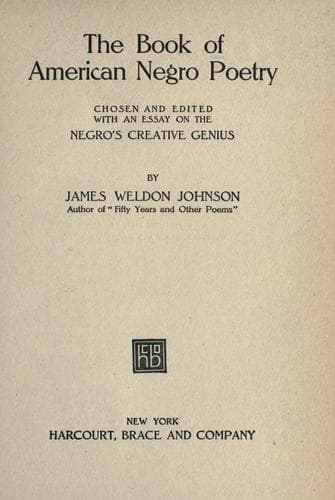
African Americans -- Poetry; American poetry -- African American authors
John W. Holloway, more than any Negro poet writing in the dialect to-day,
summons to his work the lilt, the spontaneity and charm of which Dunbar
was the supreme master whenever he employed that medium. It is well to say
a word here about the dialect poems of James Edwin Campbell. In dialect,
Campbell was a precursor of Dunbar. A comparison of his idioms and
phonetics with those of Dunbar reveals great differences. Dunbar is a
shade or two more sophisticated and his phonetics approach nearer to a
mean standard of the dialects spoken in the different sections. Campbell
is more primitive and his phonetics are those of the dialect as spoken by
the Negroes of the sea islands off the coasts of South Carolina and
Georgia, which to this day remains comparatively close to its African
roots, and is strikingly similar to the speech of the uneducated Negroes
of the West Indies. An error that confuses many persons in reading or
understanding Negro dialect is the idea that it is uniform. An ignorant
Negro of the uplands of Georgia would have almost as much difficulty in
understanding an ignorant sea island Negro as an Englishman would have.
Not even in the dialect of any particular section is a given word always
pronounced in precisely the same way. Its pronunciation depends upon the
preceding and following sounds. Sometimes the combination permits of a
liaison so close that to the uninitiated the sound of the word is almost
completely lost.
The constant effort in Negro dialect is to elide all troublesome
consonants and sounds. This negative effort may be after all only positive
laziness of the vocal organs, but the result is a softening and smoothing
which makes Negro dialect so delightfully easy for singers.
Daniel Webster Davis wrote dialect poetry at the time when Dunbar was
writing. He gained great popularity, but it did not spread beyond his own
race. Davis had unctuous humor, but he was crude. For illustration, note
the vast stretch between his "Hog Meat" and Dunbar's "When de Co'n Pone's
Hot," both of them poems on the traditional ecstasy of the Negro in
contemplation of "good things" to eat.
Public-domain text, read in full here on John Shaqi.
Reviews
Reviews
No reviews yet
Be the first to share your thoughts on this work.
Join the Discussion
Join the discussion
Sign in to leave a comment or review.
Sign InorCreate an account