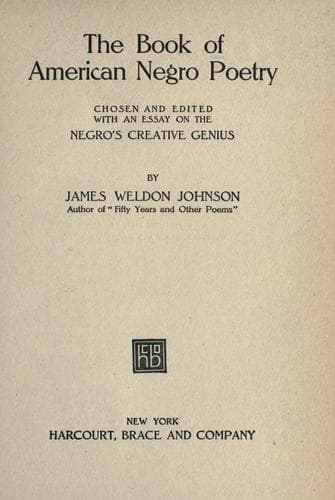
African Americans -- Poetry; American poetry -- African American authors
Later there came along a number of colored men who were able to transcribe
the old songs and write original ones. I was, about that time, writing
words to music for the music show stage in New York. I was collaborating
with my brother, J. Rosamond Johnson, and the late Bob Cole. I remember
that we appropriated about the last one of the old "jes' grew" songs. It
was a song which had been sung for years all through the South. The words
were unprintable, but the tune was irresistible, and belonged to nobody.
We took it, re-wrote the verses, telling an entirely different story from
the original, left the chorus as it was, and published the song, at first
under the name of "Will Handy." It became very popular with college boys,
especially at football games, and perhaps still is. The song was, "Oh,
Didn't He Ramble!"
In the beginning, and for quite a while, almost all of the Ragtime songs
that were deliberately composed were the work of colored writers. Now, the
colored composers, even in this particular field, are greatly outnumbered
by the white.
The reader might be curious to know if the "jes' grew" songs have ceased
to grow. No, they have not; they are growing all the time. The country has
lately been flooded with several varieties of "The Blues." These "Blues,"
too, had their origin in Memphis, and the towns along the Mississippi.
They are a sort of lament of a lover who is feeling "blue" over the loss
of his sweetheart. The "Blues" of Memphis have been adulterated so much on
Broadway that they have lost their pristine hue. But whenever you hear a
piece of music which has a strain like this in it:
[Illustration: Music]
you will know you are listening to something which belonged originally to
Beale Avenue, Memphis, Tennessee. The original "Memphis Blues," so far as
it can be credited to a composer, must be credited to Mr. W. C. Handy, a
colored musician of Memphis.
As illustrations of the genuine Ragtime song in the making, I quote the
words of two that were popular with the Southern colored soldiers in
France. Here is the first:
"Mah mammy's lyin' in her grave,
Mah daddy done run away,
Mah sister's married a gamblin' man,
An' I've done gone astray.
Yes, I've done gone astray, po' boy,
An' I've done gone astray,
Mah sister's married a gamblin' man,
An' I've done gone astray, po' boy."
These lines are crude, but they contain something of real poetry, of that
elusive thing which nobody can define and that you can only tell that it
is there when you feel it. You cannot read these lines without becoming
reflective and feeling sorry for "Po' Boy."
Now, take in this word picture of utter dejection:
"I'm jes' as misabul as I can be,
I'm unhappy even if I am free,
I'm feelin' down, I'm feelin' blue;
I wander 'round, don't know what to do.
I'm go'n lay mah haid on de railroad line,
Let de B. & O. come and pacify mah min'."
Public-domain text, read in full here on John Shaqi.
Reviews
Reviews
No reviews yet
Be the first to share your thoughts on this work.
Join the Discussion
Join the discussion
Sign in to leave a comment or review.
Sign InorCreate an account