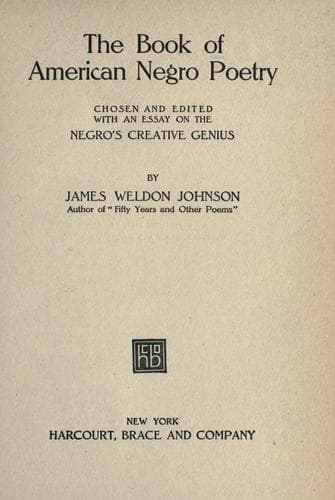
African Americans -- Poetry; American poetry -- African American authors
"I know de moonlight, I know de starlight;
I lay dis body down.
I walk in de moonlight, I walk in de starlight;
I lay dis body down.
I know de graveyard, I know de graveyard,
When I lay dis body down.
I walk in de graveyard, I walk troo de graveyard
To lay dis body down.
I lay in de grave an' stretch out my arms;
I lay dis body down.
I go to de judgment in de evenin' of de day
When I lay dis body down.
An' my soul an' yo' soul will meet in de day
When I lay dis body down."
Regarding the line, "I lay in de grave an' stretch out my arms," Col.
Thomas Wentworth Higginson of Boston, one of the first to give these slave
songs serious study, said: "Never it seems to me, since man first lived
and suffered, was his infinite longing for peace uttered more plaintively
than in that line."
These Negro folksongs constitute a vast mine of material that has been
neglected almost absolutely. The only white writers who have in recent
years given adequate attention and study to this music, that I know of,
are Mr. H.E. Krehbiel and Mrs. Natalie Curtis Burlin. We have our native
composers denying the worth and importance of this music, and trying to
manufacture grand opera out of so-called Indian themes.
But there is a great hope for the development of this music, and that hope
is the Negro himself. A worthy beginning has already been made by
Burleigh, Cook, Johnson, and Dett. And there will yet come great Negro
composers who will take this music and voice through it not only the soul
of their race, but the soul of America.
And does it not seem odd that this greatest gift of the Negro has been the
most neglected of all he possesses? Money and effort have been expended
upon his development in every direction except this. This gift has been
regarded as a kind of side show, something for occasional exhibition;
wherein it is the touchstone, it is the magic thing, it is that by which
the Negro can bridge all chasms. No persons, however hostile, can listen
to Negroes singing this wonderful music without having their hostility
melted down.
This power of the Negro to suck up the national spirit from the soil and
create something artistic and original, which, at the same time, possesses
the note of universal appeal, is due to a remarkable racial gift of
adaptability; it is more than adaptability, it is a transfusive quality.
And the Negro has exercised this transfusive quality not only here in
America, where the race lives in large numbers, but in European countries,
where the number has been almost infinitesimal.
Is it not curious to know that the greatest poet of Russia is Alexander
Pushkin, a man of African descent; that the greatest romancer of France
is Alexander Dumas, a man of African descent; and that one of the greatest
musicians of England is Coleridge-Taylor, a man of African descent?
Public-domain text, read in full here on John Shaqi.
Reviews
Reviews
No reviews yet
Be the first to share your thoughts on this work.
Join the Discussion
Join the discussion
Sign in to leave a comment or review.
Sign InorCreate an account