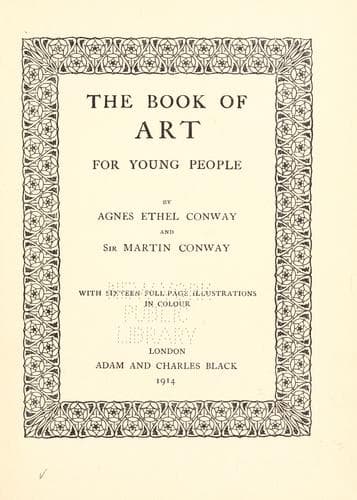
The Book of Art for Young PeopleConway, Agnes Ethel
General
The Book of Art for Young People
Conway, Agnes Ethel
Art -- Juvenile literature; Painting
clothes of the Renaissance were hardly suitable for Noah and Abraham,
so he invented a costume of his own, founded upon Roman dress, but
different from oriental or contemporary clothes. The Scripture
illustrations of Raphael most familiar to you may probably be his
cartoon designs for tapestry in the South Kensington Museum, which
were bought by Charles I. In these you can see what is meant about
the clothes, but you will not be surprised at them, because the same
have been adopted by the majority of Bible illustrators ever since
the days of Raphael. His pictures became so popular that it was thought
whatever he did must be right. The dress was a mere detail in his work,
but it was easy to copy and has been copied persistently from that
day to this. It is curious to think that the long white robes, which
Christ wears in the illustrations of our present-day Sunday School
books and other religious publications, are all due to imitation of
Raphael's designs.
The first room he finished for Julius II. was so rich in effect and
beautiful in colour that the Pope could scarcely wait for more rooms
as fine. Raphael had to call in a large number of assistants to enable
him to cover the walls fast enough to please the Pope, and the quality
of the work began to deteriorate. The uneven merit of his frescoes
foretold the consequence of overwork despite his matchless facility
and power. But in his panel pictures, when he was not hurried, his
work continued to improve until he reached his crowning achievement
in the Sistine Madonna painted three years before his death.
Raphael was thirty-seven when he died in 1520, and very far from coming
to the end of his powers of learning. Each picture that he painted
revealed to him new difficulties to conquer, and new experiments to
try, in his art. We seem compelled to think that had he lived and
laboured for another score of years, the history of painting in Italy
might have been different. In Rome and Florence no successor attempted
to improve upon his work. His pupils and assistants were more numerous
than those of any other painter, but when they had obtained some of
his facility of drawing and painting they were contented. None of them
had Raphael's genius, yet all wished to paint like him; so that for
the following fifty years Rome and Florence and Southern Italy were
flooded with inferior Raphaelesque paintings, which tended to become
more slip-shod in execution as time went on, and more devoid of any
personal note. It was just as though his imitators had learnt to write
beautifully and then had had little to say.
Public-domain text, read in full here on John Shaqi.
Reviews
Reviews
No reviews yet
Be the first to share your thoughts on this work.
Join the Discussion
Join the discussion
Sign in to leave a comment or review.
Sign InorCreate an account