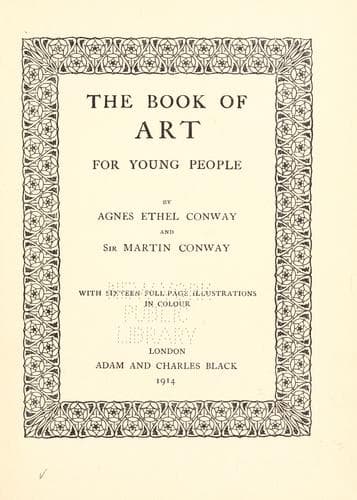
The Book of Art for Young PeopleConway, Agnes Ethel
General
The Book of Art for Young People
Conway, Agnes Ethel
Art -- Juvenile literature; Painting
A visit to Venice is one of the joys which perhaps few of us have yet
experienced. But whether we have been there or not, we all know that
the very sound of her name is enchanting for those who are fresh from
her magic--her sunrises and sunsets unmatched for colour, and her
streets for silence.
The Venetians were a proud and successful people, wealthier by virtue
of their great sea-trade than the citizens of Florence or of any other
town in Italy; their foremost men lived in great high-roomed palaces,
richly furnished, and decorated with pictures of a sumptuous pageantry.
But the Venetians were not merely a luxurious people. The poetry of
the lagoons, and the glory of the sunset skies, imparted to their lives
the wealth of a rare romance. Even in Venice to-day, now that the
steamers have spoilt the peace of the canals and the old orange-winged
sailing-boats no longer crowd against the quays, the dreamy atmosphere
of the city retains its spell.
Few artists ever felt and expressed this atmosphere better than
Giorgione, the painter of the first of our Venetian pictures. He was
one of the great artists of the Renaissance who died young, ten years
before Raphael, but their greatness is scarcely comparable. Like
Raphael, Giorgione was precocious, but unlike him he painted in a style
of his own that from the very beginning owed little to any one else.
He saw beauty in his own way, and was not impelled to see it differently
by coming into contact with other artists, however great. Unlike
Raphael, he was not a great master of the art of composition. In the
little picture before us the grouping of the figures is not what may
be called inevitable, like that in the 'Knight's Dream.' It seems as
though one day when Giorgione was musing on the beauties of the world,
and the blemishes of life, even life in Venice, he thought of some
far-off time beyond the dawn of history when all men lived in peace.
The ancient Greeks called this perfect time the 'Golden Age' of the
world. In many ways their idea of it tallies with the description of
the Garden of Eden, and they were always contrasting with it the 'Iron
Age' in which they thought they lived, as the Hebrews contrasted the
life of Adam and Eve in the garden with their own. As the fancy flashed
across Giorgione's mind, perchance he saw some just king of whom his
subjects felt no fear seated upon a throne like this. A dreamy youth
plays soft music to him, and another hands him flowers and fruit. Books
lie strewn upon the steps, and a child stands in a reverent attitude
before him. Wild and domestic animals live together in harmony; the
ground is carpeted with flowers; all is peaceful. Such a subject suited
the temperament of Giorgione, and he painted it in the romantic mood
in which it was conceived. Nothing could be further from everyday life
than this little scene. It has the unlaboured look that suits such
an improvised subject. Of course no one knows for certain that this
Public-domain text, read in full here on John Shaqi.
Reviews
Reviews
No reviews yet
Be the first to share your thoughts on this work.
Join the Discussion
Join the discussion
Sign in to leave a comment or review.
Sign InorCreate an account