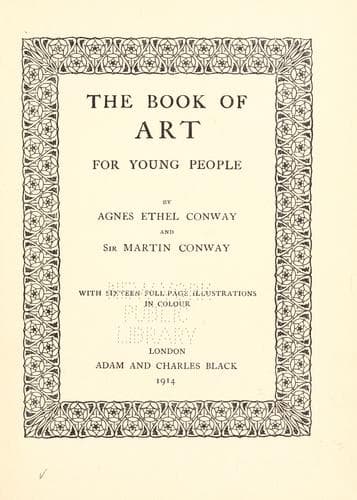
The Book of Art for Young PeopleConway, Agnes Ethel
General
The Book of Art for Young People
Conway, Agnes Ethel
Art -- Juvenile literature; Painting
It seems strange that at one time the beauty of natural landscape was
hardly perceived by any one at all. People lived in the beautiful
country and scarcely knew that it was beautiful. Then came the time
when the beauty of landscape began to be felt by the nicest people.
They began to put it into their poetry, and to talk and write about
it, and to display it in landscape pictures. It was through poems and
pictures, which they read and saw, that the general run of folks first
learned to look for beauty in nature. I have no doubt that Turner's
wonderful sunsets made plenty of people look at sunsets and rejoice
in the intricacy and splendour of their glory for the first time in
their lives. Well, what Turner and other painters of his generation
did for landscape, had had to be done for men and women in earlier
days by earlier generations of artists. The Greeks were the first,
in their sculpture, to show the wonderful beauty of the human form;
till their day people had not recognised what to us now seems obvious.
No doubt they had thought one person pretty and another handsome, but
they had not known that the human figure was essentially a glorious
thing till the Greek sculptors showed them. Another thing painters
have taught the world is the beauty of atmosphere. Formerly no one
seems to have noticed how atmosphere affects every object that is seen
through it. The painters had to show us that it is so. After we had
seen the effect of atmosphere in pictures we began to be able to see
for ourselves in nature, and thus a whole group of new pleasures in
views of nature was opened up to us.
Away back in the Middle Ages, six hundred and more years ago, folks
had far less educated eyes than we possess to-day. They looked at nature
more simply than we do and saw less in it. So they were satisfied with
pictures that omitted a great many features we cannot do without.
But painting does not only concern itself with representing the world
we actually see and the people that our eyes actually behold. It
concerns itself quite as much with the world of fancy, of make-believe.
Indeed, most painters when they look at an actual scene let their fancy
play about it, so that presently what they see and what they fancy
get mixed up together, and their pictures are a mixture of fancy and
of fact, and no one can tell where the one ends and the other begins.
The fancies of people are very different at different times, and you
can't understand the pictures of old days unless you can share the
fancies of the old painters. To do that you must know something about
the way they lived and the things they believed, and what they hoped
for and what they were afraid of.
Public-domain text, read in full here on John Shaqi.
Reviews
Reviews
No reviews yet
Be the first to share your thoughts on this work.
Join the Discussion
Join the discussion
Sign in to leave a comment or review.
Sign InorCreate an account