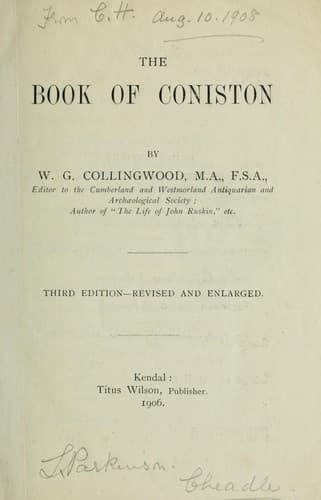
In 1797 the landscape painter Turner came here as a youth of 23
on his first tour through the north. After his pilgrimage among
the Yorkshire abbeys, so finely described by Ruskin in _Modern
Painters_, vol. v., the young artist seems to have arrived among
the fells one autumn evening, and sketched the Old Man from the
Half-penny Alehouse. Then--I piece this together from the drawings
and circumstances--he went round to spend the night at the Black
Bull with old Tom Robinson and his wife, the daughter of Wonderful
Walker. She was a wonderful woman herself; had been first a
miner's wife, helping him to rise to a clerkship at the Leadhill
Mines in Dumfriesshire, and on his death returning to Seathwaite;
then, sorely against her old father's will, taking up with Tom,
and settling at Townend to farm; afterwards for many years at the
Black Bull, keeping the inn, managing the carding mill, and acting
as parish officer in her turn; a notable figure, in mob cap and
bedgown and brat; sharp tongued and shrewd of judgment. What
did she make, I wonder, of the sunburnt, broad-shouldered lile
cockney, with his long brown curls, his big nose and eagle eyes,
and his sketch-book, "spying fancies?" Early in the morning he
was out and scrambling up Lang Crags. It was one of the magical,
misty autumnal sunrises we know so well. There had been rain, and
Whitegill was full, thundering down the precipice at his feet.
The fog was breaking away from the valley beneath, and rising in
drifts and swirls among the clefts of Raven Crag, and the woods
of Tilberthwaite. Far away, serene in the morning light, stood
Helvellyn. It was his earliest sight of the mountain glory; the
thrill of emotions never to be forgotten. Going home to London,
he painted his first great mountain subject, afterwards in the
National Gallery--the first picture for which he was moved to
quote poetry in the Academy catalogue, and this from _Paradise
Lost_--"Morning on Coniston Fells:--
Ye mists and exhalations that now rise
From hill or streaming lake, dusky or grey,
Till the sun paint your fleecy skirts with gold
In honour to the world's Great Author rise."
By this time the fashion of visiting the lakes was coming in,
enough to give employment to a guide--Creighton, whom Captain
Budworth, about 1790, described as a self-taught scholar, claiming
descent from a noble family in Scotland, and fond of bragging
about the nobility he had taken up the fells. His son William
was something of a genius; he was found here by John Southern
of Soho drawing a map of the world with home-made mathematical
instruments, but using them with immense skill. Mr. Southern took
him into his drawing office, and young Creighton, by hard study,
became a considerable linguist, astronomer, and cartographer.
Public-domain text, read in full here on John Shaqi.
Reviews
Reviews
No reviews yet
Be the first to share your thoughts on this work.
Join the Discussion
Join the discussion
Sign in to leave a comment or review.
Sign InorCreate an account