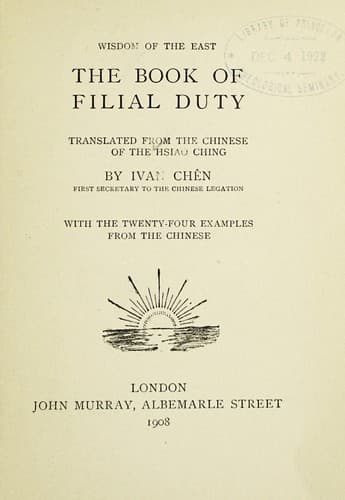
The _Hsiao Ching_, or _Book of Filial Duty_, is generally held to be
the work of an unknown pupil of Tsêng Ts‘an, the disciple of Confucius,
to whom is attributed the famous Confucian classic known as _The
Greater Learning_. Certainly it can be traced back as far as 400 B.C.,
within a century from the death of Confucius. The preservation of
the text in its present form is due to the Emperor Ming Huang (A.D.
685-762), one of the most fascinating characters in Chinese history,
who had it engraved, together with eleven other of the Confucian
writings, on tablets of stone and set up in his capital of Chang-an. He
afterwards added a commentary of his own, which is still extant, and
has proved invaluable to all commentators of a later period. _The Book
of Filial Duty_ is often found in China bound up with another treatise
called the _Hsiao Hsüeh_, or _Teaching for the Young_, of which the
following is a specimen: “The way to become a student is with meekness
and humility, receiving with confidence every word spoken by the
master. The pupil, when he sees men of virtue, should try to follow
in their steps; when he hears wise sayings, he should try to conform
to them. He must not harbour evil designs, but always act honourably.
Whether at home or abroad, he must have a fixed abode, and resort with
those who are well disposed, regulating his demeanour with care, and
curbing the passions.”
Few books have enjoyed greater popularity amongst all classes in
China than _The Book of Filial Duty_. It may be called _The Book of
Emperors_, from the fact that so many Emperors, both before and after
Ming Huang, have commentated upon it. Equally it is _The Book of
Youth_, being the first treatise of importance placed in the hands of
children, after the horn books of elementary instruction. The reason
for its survival after so many centuries is not hard to seek. Family
life has always been, from time immemorial, the foundation-stone
of the Chinese Empire, and filial piety is the foundation-stone of
family life. Nor does this duty of son to father merely extend to
the living. The living head of the family pays due reverence to the
countless ancestors who have preceded him. A witty Chinese writer
once remarked that in the West family life only began after death—in
the family vault. Here, at any rate, after years of separation and
divided interests, the members met to enjoy a common oblivion. I cannot
but think that there is some exaggeration in this; yet not even the
greatest apologist of Western methods will venture to deny that the
Chinese and indeed most Oriental ideals of family life are superior to
his own. Whilst living, only the calls of Empire, or the demands of
their profession, may keep relations apart; but the interests of the
family are always greater than the interests of the individual, and no
exile is without hope of return to the home of his fathers. The dead
will not be forgotten, for it will be the duty of their sons to offer
Public-domain text, read in full here on John Shaqi.
Reviews
Reviews
No reviews yet
Be the first to share your thoughts on this work.
Join the Discussion
Join the discussion
Sign in to leave a comment or review.
Sign InorCreate an account