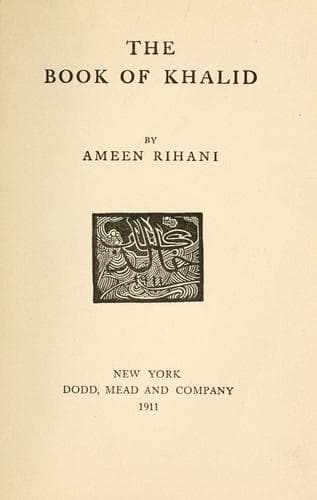
Arab Americans -- Fiction; Immigrants -- New York (State) -- New York -- Fiction
"I visit the Statue for the love of my mother, and mounting to the
top of the pedestal, I look up and behold my mother before me. The
spectre of her, standing before the monument, looks down upon me,
reproachfully, piteously, affectionately. I sit down at the feet
of the Virgin Mary and bury my face in my hands and weep. I love
what thou lovest, O my mother, but I can see no more what thou seest.
For thy love, O my mother, these kisses and tears. For thy love, I
stand here like a child, and look up to this inanimate figure as I
did when I was an acolyte. My intellect, O my mother, I would
drown in my tears, and thy faith I would stifle with my kisses. Only
thus is reconciliation possible.
"Leaving this throne of modern mythology, I cross many wadis, descend
and ascend many hills, pass through many villages, until I reach, at
Ghina and Masshnaka, the tomb of the mythology of the ancients. At
Ghina are ruins and monuments, of which Time has spared enough to
engage the interest of archæologists. Let the Pères Jesuit,
Bourquenoud and Roz, make boast of their discoveries and scholarship;
I can only boast of the fact that the ceremonialisms of worship are
the same to-day as they were in the days of my Phoenician ancestors.
Which, indeed, speaks well for THEM. This tablet, representing an
armed figure and a bear, commemorates, it is said, the death of
Tammuz. And the figure of the weeping woman near it is probably that
of Ashtaroth. Other figures there are; but nothing short of the
scholarship of Bourquenoud and Roz can unveil their marble mystery.
"At Masshnaka, overlooking the River Adonis, are ruins of an ancient
temple in which can still be seen a few Corinthian columns. This, too,
we are told, was consecrated to Tammuz; and in this valley the women
of Byblus bemoaned every year the fate of their god. Isis and Osiris,
Tammuz and Ashtaroth, Venus and Adonis,--these, I believe, are one and
the same. Their myth borrowed from the Phoenicians, the Egyptians, and
the Romans, from either of the two. But the Venus of Rome is cheerful,
joyous, that of the Phoenicians is sad and sorrowful. Even mythology
triumphs in its evolution.
Public-domain text, read in full here on John Shaqi.
Reviews
Reviews
No reviews yet
Be the first to share your thoughts on this work.
Elsewhere in the archive
Join the Discussion
Join the discussion
Sign in to leave a comment or review.
Sign InorCreate an account