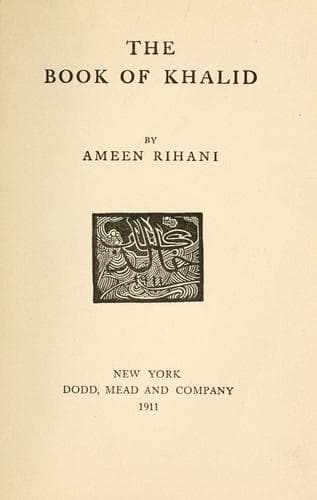
Arab Americans -- Fiction; Immigrants -- New York (State) -- New York -- Fiction
"Her son, a youth of not more than two score years, returns from his
day's labour a while after I had arrived. And as he stands in the
door, his pick-axe and spade on his shoulder, his sister runs to meet
him, and whispers somewhat about the stranger. Sitting on the
threshold, he takes off his spats of cloth and his clouted shoes,
while she gets the pitcher of water. After having washed, he enters,
salaams graciously, and squats on the floor. The mother then brings a
wicker tray on which is set the supper, consisting of only bread and
olives. 'Thou wilt overlook our penury,' she falters out; 'here be all
we have.' In truth, my hostess is of the poorest of the Lebanon
peasants; even her sweet-oil pipkin and her jars of lentils and beans,
are empty. She lays the tray before her son and invites me to partake
of the repast. I go to my basket, bring forth the few onions and the
two cakes of cheese I had left, lay them with an apology on the
tray--the mother, abashed, protests--and we sit down cross-legged in a
circle to supper. When we rise, the little girl lights a little fire,
and they enjoy the cup of coffee I make for them. And the mother, in
taking hers, tells me naïvely, and with a sigh, that it is five years
now since she had had a cup of coffee. Indeed, she had seen better
days. And 'tis sorrow, forestalling Time, which furrows her cheeks and
robs her black eyes of their lustre and spark.
"She had once cattle, and a beit of her own, and rugs, too, and jars
full of provision. But now she is a tenant. And her husband, ever
since he emigrated to America, did not send a single piaster or even
write a letter. From necessity she becomes a prey of usurers; for
those Lebanon Moths, of which we saw a specimen in the village of
bells and potteries, fall mostly in the wardrobe of women. They are
locusts rather, who visit only the wheat fields of the poor. Her home
was mortgaged to one such, and failing to meet her obligation, the
mortgage is closed and he takes possession. Soon after she is evicted,
her son, the first-born, a youth of much promise, dies.
"'He could read and write, my son,' quoth she, sobbing; 'of a sharp
wit he was, and very assiduous in his studies. Once he accompanied the
priest of the village on a visit to the Patriarch, and read there a
eulogium of his own composition, for which he received a silver medal.
The Patriarch then sent him to a Seminary; he was to become a priest,
my son. He wrote a beautiful hand--both Arabic and French; he was of a
fine wit, sharp, quick, brilliant. Ah, me, but those who are of such
minds never live!'
Public-domain text, read in full here on John Shaqi.
Reviews
Reviews
No reviews yet
Be the first to share your thoughts on this work.
Elsewhere in the archive
Join the Discussion
Join the discussion
Sign in to leave a comment or review.
Sign InorCreate an account