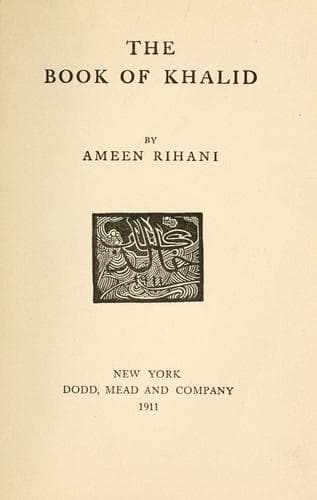
Arab Americans -- Fiction; Immigrants -- New York (State) -- New York -- Fiction
"She then tells me how they lost their last head of cattle. An
excellent sheep it was; which one night they forgot outside; and the
wolf, visiting the village, sees it tied to the mulberry, howls for
joy, and carries it off. And thus Death robs the poor woman of her
son; America, of her husband; the Shylock of the village, of her home;
and the wolf, of her last head of cattle. And this were enough to age
even a Spartan woman. Late in the evening, after she had related at
length of her sorrows, three mattresses--all she had--are laid on the
straw mat near each other, and the little girl had to sleep with her
mother.
"Early in the morning I bid them farewell, and pass on my way to
Amsheet, where Henriette Renan, the sister of Ernest, is buried. An
hour's walk, and the incarcerated wadi and its folk lie concealed
behind. I breathe again the open air of the mountain expanse; I behold
again the emerald stretch of water on the horizon, where the baggalas
and saics, from this distance, seem like doves basking in the morning
sun. I cross the last rill, mount the last hilltop on my journey, and
lo, at the foot of the gently sloping heath are the orchards and palms
of Amsheet. Further below is Jbail, or ancient Byblus, looking like a
clutter of cliffs on the shore. Farewell to the mountain heights, and
the arid wilderness! Welcome the fertile plains, and hopeful strands.
In half an hour I reach the immense building--the first or the last of
the village, according to your direction--which, from the top of the
hill, I thought to be a fortress. A huge structure this, still
a-building, and of an architecture altogether different from the
conventional Lebanon type. No plain square affair, with three pointed
arches in the façade, and a gable of pink tiles; but here are quoins,
oriels, embrasures, segmental arches, and other luxuries of
architecture. Out of place in these wilds, altogether out of place.
Hard by are two primitive flat-roofed beits, standing grimly there as
a rebuke to the extravagant tendencies of the age. I go there in the
hope of buying some cheese and eggs, and behold a lady of severe
beauty smoking a narghilah and giving orders to a servant. She returns
my salaam seated in her chair, and tells me in an injured air, after I
had made known to her my desire, that eggs and cheese are sold in the
stores.
"'You may come in for breakfast,' she adds; and clapping for the
servant, orders him to lay the table for me. I enter the beit, which
is partitioned into a kitchen, a dining-room, and a parlour. On the
table is spread the usual breakfast of a Lebanonese of affluence:
namely, cheese, honey, fig-jam, and green olives. The servant, who is
curious to know my name, my religion, my destination, and so forth,
tells me afterwards that Madame is the wife of the kaiemkam, and the
castle, which is building, is their new home.
Public-domain text, read in full here on John Shaqi.
Reviews
Reviews
No reviews yet
Be the first to share your thoughts on this work.
Elsewhere in the archive
Join the Discussion
Join the discussion
Sign in to leave a comment or review.
Sign InorCreate an account