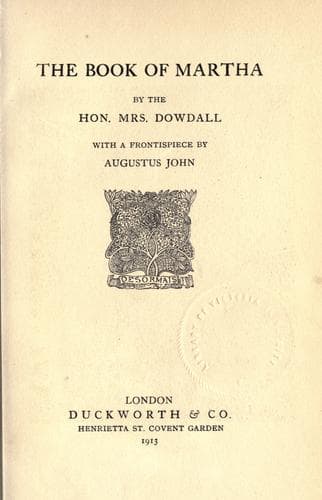
England -- Social life and customs -- Humor; English wit and humor; Housekeeping -- Humor; Marriage -- Humor
“Quite a large membership now, have we not?” said Mrs. Flockson,
sitting down in an attitude of faded gloom that infected us both
like a disease. I began to be conscious of my back, and my legs, and
petticoats and things that I was usually unaware of. “I shall be so
interested to hear what Miss Jamieson has to say about children’s toys.
It is so important, is it not?”
“I don’t think so,” said Mrs. Figgins crisply. “I don’t think it is
at all important, but they would have it. I had much rather they
had spoken about children’s manners; they are dreadful in this
neighbourhood.”
“Yes, of course, some are very bad,” sighed Mrs. Flockson, “but it is
so difficult, isn’t it, to know just where to draw the line without
being too severe. They say now it is so important that the character
should be developed along its natural lines. It is so difficult not to
impose one’s own individuality too much, and yet to preserve the idea
of everything that is sweet and gracious.”
Now, if I had been alone I could have managed her perfectly. I could
have kept Mrs. Flockson happy without doing her an atom of harm, but
Mrs. Figgins is so abrupt.
“I can’t stop to think about individuality when a child is gobbling
and talking nonsense at the same time,” she said. “I tell it at once,
‘Don’t eat like a pig,’ and then it doesn’t. I don’t care whether I am
imposing my individuality or that of any other self-respecting person
who wishes to eat with Christians.”
Several more people came in then. They were mostly badly dressed,
and evidently put all their money on expression so far as charm was
concerned; but then when people are very much in earnest about things
that are of no consequence, and have as much consciousness as rabbits,
and are not very healthy, it is difficult to make them look nice.
Miss Jamieson, a capable pink lady in a well-made dress with irrelevant
trimming, spoke for half an hour on the question of children’s toys.
She told us what toys ought to mean, and the qualities they ought to
foster in the child. How, if his taste were trained in this manner, he
would more easily distinguish the good from the bad later on. I asked
whether a good taste in dolls acquired in the nursery would help my son
not to fall in love with the wrong kind of minx. I did not put it in
just those words, but Miss Jamieson did not give me much comfort. She
smiled kindly, and said my question hardly came within the scope of her
paper, but she was sure a taste in dolls would help very much, only
boys did not play much with dolls, did they?
Public-domain text, read in full here on John Shaqi.
Reviews
Reviews
No reviews yet
Be the first to share your thoughts on this work.
Elsewhere in the archive
Join the Discussion
Join the discussion
Sign in to leave a comment or review.
Sign InorCreate an account