Produced by Sankar Viswanathan, Chris Curnow, Lindy Walsh,
and the Online Distributed Proofreading Team at
http://www.pgdp.net
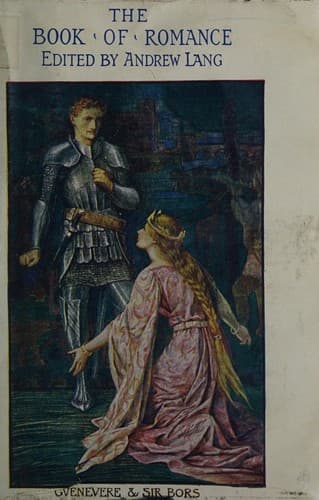
[Illustration: LANCELOT BEARS OFF GUENEVERE (p. 153)]
THE
BOOK OF ROMANCE
EDITED BY
ANDREW LANG
_WITH NUMEROUS ILLUSTRATIONS BY H. J. FORD_
LONGMANS, GREEN, AND CO.
39 PATERNOSTER ROW, LONDON
NEW YORK AND BOMBAY
1902
Copyright 1902
BY
LONGMANS, GREEN, & CO.
* * * * *
_PREFACE_
It is to be supposed that children do not read Prefaces; these are
Bluebeard's rooms, which they are not curious to unlock. A few words
may therefore be said about the Romances contained in this book. In
the editor's opinion, romances are only fairy tales grown up. The
whole mass of the plot and incident of romance was invented by nobody
knows who, nobody knows when, nobody knows where. Almost every people
has the Cinderella story, with all sorts of variations: a boy hero in
place of a girl heroine, a beast in place of a fairy godmother, and so
on. The Zuñis, an agricultural tribe of New Mexico, have a version in
which the moral turns out to be against poor Cinderella, who comes to
an ill end. The Red Indians have the tale of Orpheus and Eurydice,
told in a very touching shape, but without the music. On the other
hand, the negroes in the States have the Orpheus tale, adapted to
plantation life, in a form which is certainly borrowed from Europeans.
This version was sent to me some years ago, by Mr. Barnet Phillips,
Brooklyn, New York, and I give it here for its curiosity. If the
proper names, Jim Orpus and Dicey, had not been given, we might not
feel absolutely certain that the story was borrowed. It is a good
example of adaptation from the heroic age of Greece to the servile age
of Africans.
DICEY AND ORPUS
Public-domain text, read in full here on John Shaqi.
Reviews
Reviews
No reviews yet
Be the first to share your thoughts on this work.
Join the Discussion
Join the discussion
Sign in to leave a comment or review.
Sign InorCreate an account