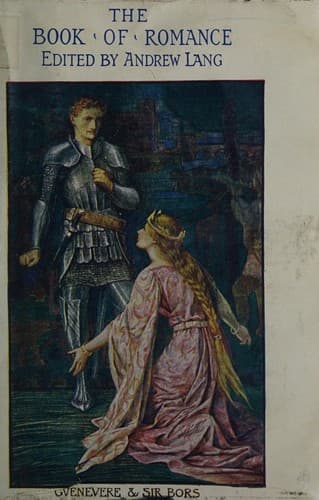
This is a mysterious part of the adventures of King Arthur's Knights.
We must remember that parts of these stories are very old; they were
invented by the heathen Welsh, or by the ancient Britons, from whom
the Welsh are descended, and by the old pagan Irish, who spoke Gaelic,
a language not very unlike Welsh. Then these ancient stories were
translated by French and other foreign writers, and Christian beliefs
and chivalrous customs were added in the French romances, and,
finally, the French was translated into English about the time of
Edward IV. by Sir Thomas Malory, who altered as he pleased. The Story
of the Holy Graal, in this book, is mostly taken from Malory, but
partly from 'The High History of the Holy Graal,' translated by Dr.
Sebastian Evans from an old French book.
What _was_ the Holy Graal? In the stories it is the holy vessel used
by our Lord, and brought to Britain by Joseph of Arimathea. But in the
older heathen Irish stories there is a mysterious vessel of a magical
sort, full of miraculous food, and probably the French writers of the
romances confused this with the sacred vessel brought from the Holy
Land. On account of the sins of men this relic was made invisible, but
now and then it appeared, borne by angels or floating in a heavenly
light. The Knights, against King Arthur's wish, made a vow to find it,
and gave up their duties of redressing wrongs and keeping order, to
pursue the beautiful vision. But most of them, for their sins, were
unsuccessful, like Sir Lancelot, and the Round Table was scattered
and the kingdom was weakened by the neglect of ordinary duties in the
search for what could never be gained by mortal men. This appears to
be the moral of the story, if it has any moral. But the stories are
confused almost like a dream, though it is a beautiful dream.
I
HOW THE KING WENT ON PILGRIMAGE, AND HIS
SQUIRE WAS SLAIN IN A DREAM
Now the King was minded to go on a pilgrimage, and he agreed with the
Queen that he would set forth to seek the holy chapel of St.
Augustine, which is in the White Forest, and may only be found by
adventure. Much he wished to undertake the quest alone, but this the
Queen would not suffer, and to do her pleasure he consented that a
youth, tall and strong of limb, should ride with him as his squire.
Chaus was the youth's name, and he was son to Gwain li Aoutres. 'Lie
within to-night,' commanded the King, 'and take heed that my horse be
saddled at break of day, and my arms ready.' 'At your pleasure, Sir,'
answered the youth, whose heart rejoiced because he was going alone
with the King.
As night came on, all the Knights quitted the hall, but Chaus the
squire stayed where he was, and would not take off his clothes or his
shoes, lest sleep should fall on him and he might not be ready when
the King called him. So he sat himself down by the great fire, but in
spite of his will sleep fell heavily on him, and he dreamed a strange
dream.
Public-domain text, read in full here on John Shaqi.
Reviews
Reviews
No reviews yet
Be the first to share your thoughts on this work.
Join the Discussion
Join the discussion
Sign in to leave a comment or review.
Sign InorCreate an account