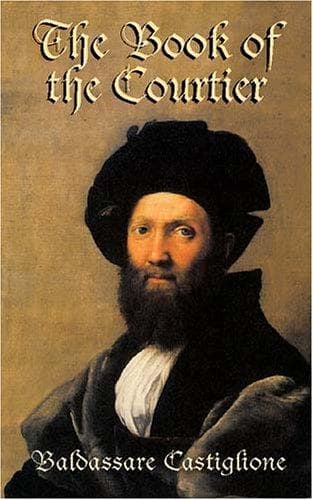
The Book of the CourtierCastiglione, Baldassarre, conte
History
The Book of the Courtier
Castiglione, Baldassarre, conte
Courtesy -- Early works to 1800; Courts and courtiers -- Early works to 1800
And since you had no knowledge in their lifetime either of my lady
Duchess or of the others who are dead (except Duke Giuliano and the
Cardinal of Santa Maria in Portico), in order to give you that knowledge
after their death as far as I can, I send you this book as a picture of
the Court of Urbino, not by the hand of Raphael[98] or Michelangelo,[99]
but of a humble painter, who knows only how to trace the chief lines,
and cannot adorn truth with bright colouring, or by perspective art make
that which is not seem to be. And although I tried to show forth in
their discourse the qualities and character of my personages, I own I
failed to express or even to suggest the excellences of my lady Duchess,
not only because my style is inadequate to describe them, but because my
intelligence fails even to conceive of them;[13] and if I be censured
for this or any other matter worthy of censure (for I well know that my
book contains many such), I shall not gainsay the truth.
2.—But as men sometimes so delight in finding fault that they reprehend
even that which does not merit reprehension, to such as blame me because
I did not imitate Boccaccio[14] or conform to the usages of present
Tuscan speech, I shall not refrain from saying that while, for his time,
Boccaccio had a charming faculty and often wrote with care and
diligence, yet he wrote far better when he followed only the guidance of
his natural wit and instinct, without further thought or care to polish
his writings, than when he strove industriously and laboriously to be
more refined and correct. For this reason even his followers declare
that he greatly erred in judgment concerning his own works, holding
cheap what did him honour[15] and prizing what was worthless. Therefore,
if I had imitated that manner of writing which in Boccaccio is censured
by those who elsewise praise him, I should not have been able to escape
those same aspersions that were cast on him in this regard; and I should
have more deserved them, because he committed his faults thinking he was
doing well, while I should have known I was doing ill. Again, if I had
imitated the style now admired by many but less esteemed by him, it
seemed to me that by such imitation I should show myself at variance
with him whom I was imitating, a thing I deemed unseemly. And again, if
this consideration had not moved me, I was not able to imitate him in my
subject-matter, for he never wrote anything at all in the manner of
these books of the Courtier; and I thought I ought not to imitate him in
language, because the power and true law of good speech consist rather
in usage than in aught else, and it is always a bad habit to employ
words not in use. Therefore it was not meet for me to borrow many of
Boccaccio’s words that were used in his day, but are not now used even
by the Tuscans themselves.
Public-domain text, read in full here on John Shaqi.
Reviews
Reviews
No reviews yet
Be the first to share your thoughts on this work.
Join the Discussion
Join the discussion
Sign in to leave a comment or review.
Sign InorCreate an account