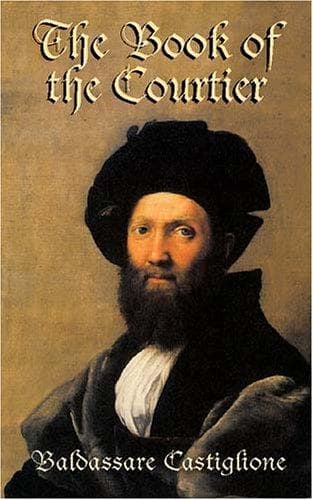
The Book of the CourtierCastiglione, Baldassarre, conte
History
The Book of the Courtier
Castiglione, Baldassarre, conte
Courtesy -- Early works to 1800; Courts and courtiers -- Early works to 1800
Hence if in writing I have chosen not to use those words of Boccaccio
that are no longer used in Tuscany, nor to conform to the rule of those
who deem it not permissible to use any words that the Tuscans of to-day
do not use, I seem to myself excusable. And I think that both in the
matter and in the language of my book (so far as one language can aid
another), I have followed authors as worthy of praise as is Boccaccio.
Nor do I believe that it ought to be counted against me as a fault that
I have elected to make myself known rather as a Lombard speaking
Lombard, than as a non-Tuscan speaking Tuscan too precisely, in order
that I might not resemble Theophrastus, who was detected as non-Athenian
by a simple old woman, because he spoke the Athenian dialect with excess
of care.[16]
But as this subject is sufficiently treated of in my first Book,[17] I
shall say no more, except that, to prevent all possible discussion, I
grant my critics that I do not know this Tuscan dialect of theirs, which
is so difficult and recondite. And I declare that I have written in my
own dialect, just as I speak and for those who speak as I do; and in
this I think I have wronged no man, because it seems to me that no one
is forbidden to write and speak in his own language; nor is anyone bound
to read or listen to what does not please him. Therefore if these folk
do not care to read my Courtier, I shall not hold myself in the least
wronged by them.
3.—Others say that since it is so very hard and well nigh impossible to
find a man as perfect as I wish the Courtier to be, it was superfluous
to write of him, because it is folly to teach what cannot be learned. To
these I make answer that I am content to have erred in company with
Plato, Xenophon and Marcus Tullius, leaving on one side all discussion
about the Intelligible World and Ideals; among which, just as are
included (according to those authors) the ideal of the perfect State, of
the perfect King and of the perfect Orator,[18] so also is the ideal of
the perfect Courtier. And if in my style I have failed to approach the
image of this ideal, it will be so much the easier for courtiers to
approach in deeds the aim and goal that I have set them by my writing;
and even if they fail to attain the perfection, such as it is, that I
have tried to express, he that approaches nearest to it will be the most
perfect; just as when many archers shoot at a target and none hit the
very mark, surely he that comes nearest to it is better than the rest.
Public-domain text, read in full here on John Shaqi.
Reviews
Reviews
No reviews yet
Be the first to share your thoughts on this work.
Join the Discussion
Join the discussion
Sign in to leave a comment or review.
Sign InorCreate an account