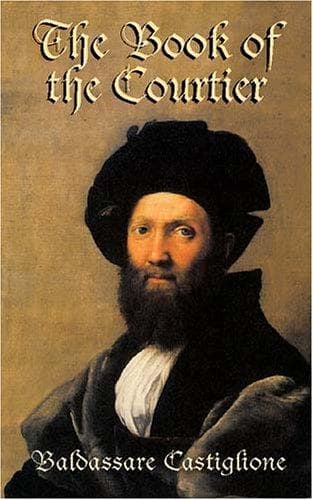
The Book of the CourtierCastiglione, Baldassarre, conte
History
The Book of the Courtier
Castiglione, Baldassarre, conte
Courtesy -- Early works to 1800; Courts and courtiers -- Early works to 1800
“Still another man at Padua said that Calfurnio[230] was so named
because he was accustomed to heat (_s_cal_dare_) ovens (_forni_). And
when I one day asked Fedra[231] why it was that on Good Friday, while
the Church offered prayer not only for Christians but even for pagans
and Jews, no mention is made of cardinals along with bishops and other
prelates,—he answered me that cardinals were included in that prayer
which says: ‘Let us pray for heretics and schismatics.’
“And our friend Count Ludovico said that the reason why I censured a
lady for using a certain cosmetic that gave a high polish, was because I
saw myself in her face, when it was painted, as in a mirrour; and being
ill favoured I could have no wish to see myself.
“Of this kind was that retort of messer Camillo Paleotto[232] to messer
Antonio Porcaro,[233] who, in speaking of a companion who told the
priest at confession that he fasted zealously, attended mass and the
sacred offices, and did all the good in the world, said: ‘The man
praises himself instead of owning his sins;’ to which messer Camillo
replied: ‘Nay, he confesses these things because he thinks it a great
sin to do them.’
“Do you not remember what a good thing my lord Prefect said the other
day? When Giantommaso Galeotto[234] was surprised at a man’s asking two
hundred ducats for a horse, because, as Giantommaso said, it was not
worth a farthing and among other defects was so afraid of weapons that
no one could make it come near them,—my lord Prefect (wishing to twit
the man with cowardice) said: ‘If the horse has this trick of running
away from weapons, I wonder that he does not ask a thousand ducats for
it.’
63.—“Moreover the very same word is sometimes employed, but in a sense
different from the usual one. As when my lord Duke,[2] being about to
cross a very rapid river, said to a trumpeter: ‘Cross over’ (_passa_);
and the trumpeter turned cap in hand, and said respectfully: ‘After your
Lordship’ (_passi la Signoria Vostra_).
[Illustration:
TOMMASO INGHIRAMI
“FEDRA”
1470?-1516
]
Reduced from Braun’s photograph (no. 42.171) of the portrait, in the
Pitti Gallery at Florence, long attributed to Raphael (1483-1520),
but pronounced by Morelli to be a copy, by a non-Italian painter, of
the original Raphael owned by the Inghirami family at Volterra and
now ruined by restoration.
“Another amusing kind of banter is where a man takes the speaker’s words
but not his sense. As was the case this year when a German at Rome,
meeting one evening with our friend messer Filippo Beroaldo,[235] whose
pupil he was, said: _Domine magister, Deus det vobis bonum sero_;[236]
and Beroaldo at once replied: _Tibi malum cito_.[237]
“Again, Diego de Chignones[238] being at the Great Captain’s[239] table,
another Spaniard, who was eating with them, said: ‘_Vino_,‘ meaning to
ask for drink; Diego replied: ’_Y no lo conocistes_,’[240] meaning to
taunt the man with being a heretic.[241]
Public-domain text, read in full here on John Shaqi.
Reviews
Reviews
No reviews yet
Be the first to share your thoughts on this work.
Elsewhere in the archive
Join the Discussion
Join the discussion
Sign in to leave a comment or review.
Sign InorCreate an account