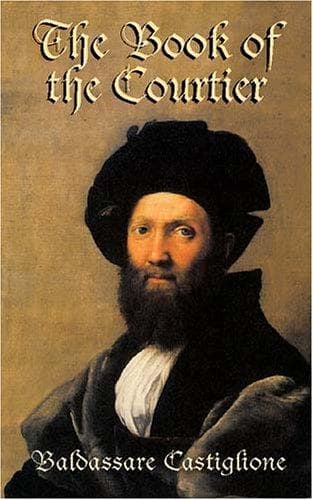
The Book of the CourtierCastiglione, Baldassarre, conte
History
The Book of the Courtier
Castiglione, Baldassarre, conte
Courtesy -- Early works to 1800; Courts and courtiers -- Early works to 1800
“Of this kind also was what your Urbino physician, master Serafino, said
to a rustic, who had received a hard blow in the eye so that it was
forced quite out, yet decided to seek aid from master Serafino. On
seeing him, although aware that it was impossible to cure him, still in
order to force money from his hands (just as the blow had forced the eye
from his head), the doctor readily promised to cure him, and accordingly
demanded money from him every day, affirming that he would begin to
recover his sight within five or six days. The poor rustic gave what
little he had; then, seeing that the affair was progressing slowly, he
began to complain of the physician, and to say that he felt no benefit
at all and saw no more with that eye than as if he had it not in his
head. At last master Serafino, seeing that he would be able to extort
little more from the man, said: ‘Brother, you must have patience. You
have lost your eye and there is no longer any help for it; and may God
grant that you do not lose your other eye as well.’ On hearing this, the
rustic began to weep and complain loudly, and said: ‘Master, you have
ruined me and stolen my money. I will complain to my lord Duke;’ and he
made the greatest outcry in the world. Then, to clear himself, master
Serafino said angrily: ‘Ah, wretched traitor! So you would have two
eyes, as city-folk and rich men have? To perdition with you!’ and
accompanied these words with such fury that the poor rustic was
frightened into silence and quietly went his way in peace, believing
himself to be in the wrong.
78.—“It is also fine to explain or interpret a thing jocosely. As when
at the court of Spain there appeared one morning in the palace a
cavalier who was very ugly, and his wife who was very beautiful, both
dressed in white damask (_damasco_),—the queen[283] said to Alonso
Carillo: ‘What think you of these two, Alonso?’ ‘My Lady,’ replied
Alonso, ‘I think she is the _dama_ (lady), and he is the _asco_,’ which
means monster.
[Illustration:
FRANCESCO ALIDOSI
CARDINAL OF PAVIA
Died 1511
]
Reduced from Giraudon’s photograph (no. 1528) of an anonymous bas-relief
in the Louvre. The features strikingly resemble those of Francesco
Francia’s medal of Alidosi, but are very unlike those shown in a
picture by Raphael (in the Prado Gallery at Madrid), which M. Müntz
regards as a portrait of the same personage. See _L’Archivio Storico
dell’Arte_ for 1891, pp. 328-32.
“Another time Rafaello de’ Pazzi[284] saw a letter which the Prior of
Messina[285] had written to a lady of his acquaintance, the
superscription of which read, ‘This missive is to be delivered to the
author of my woes.’ ‘Methinks,’ said Rafaello, ‘this letter is intended
for Paolo Tolosa.’[286] Imagine how the bystanders laughed, when
everyone knew that Paolo Tolosa had lent the Prior ten thousand ducats,
and that he, being a great spendthrift, found no means to repay them.
Public-domain text, read in full here on John Shaqi.
Reviews
Reviews
No reviews yet
Be the first to share your thoughts on this work.
Elsewhere in the archive
Join the Discussion
Join the discussion
Sign in to leave a comment or review.
Sign InorCreate an account