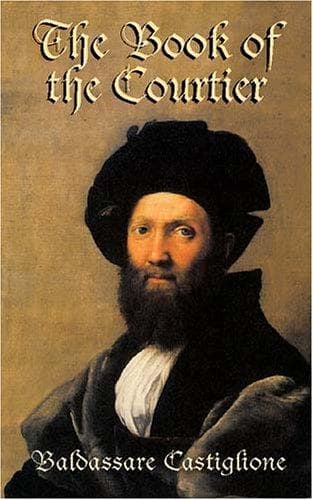
The Book of the CourtierCastiglione, Baldassarre, conte
History
The Book of the Courtier
Castiglione, Baldassarre, conte
Courtesy -- Early works to 1800; Courts and courtiers -- Early works to 1800
“My Lady, I am so great an enemy to guile, that I am forced to
contradict my lord Ottaviano, who, from having (as I fear) conspired
secretly with my lord Gaspar against women, has fallen into two errours
to my thinking very grave: one of which is, that in order to set this
Courtier above the Court Lady and make him transcend the bounds that she
can reach, my lord Ottaviano has set the Courtier also above the prince,
which is most unseemly; the other is in setting him such a goal that it
is always difficult, and sometimes impossible for him to reach it, and
that even when he does reach it, he ought not to be called a Courtier.”
“I do not understand,” said my lady Emilia, “how it should be so
difficult or impossible for the Courtier to reach this goal of his, nor
yet how my lord Ottaviano has set him above the prince.”[465]
“Do not grant him these things,” replied my lord Ottaviano, “for I have
not set the Courtier above the prince, nor do I think I have fallen into
any errour touching the aim of Courtiership.”
Then the Magnifico Giuliano replied:
“You cannot say, my lord Ottaviano, that the cause which gives a certain
quality to a result, does not always have more of that quality than its
result has. Thus the Courtier, through whose instruction the prince is
to become so excellent, must needs be more excellent than his prince;
and in this way he will also be of greater dignity than the prince
himself, which is most unseemly.
“Then, as for the aim of Courtiership, what you said may be true when
the prince’s age is little different from the Courtier’s, but still not
without difficulty, for where there is small difference in age, it is
natural that there should be small difference in knowledge also; while
if the prince is old and the Courtier young, it is fitting that the old
prince should know more than the young Courtier; and if this does not
always happen, it happens sometimes, and then the goal which you set the
Courtier is impossible. Again, if the prince is young and the Courtier
old, the Courtier can hardly win the prince’s mind by means of those
accomplishments that you have ascribed to him. For to say the truth,
jousting and other exercises of the person belong to young men and do
not befit old men, and music and dancing and festivals and games and
love-making are ridiculous in old age; and methinks they would be very
ill-befitting a director of the prince’s life and behaviour, who ought
to be a very sober person of authority, mature in years and experience,
and (if possible) a good philosopher, a good commander, and ought to
know almost everything.
“Therefore I think that whoever instructs the prince ought not to be
called a Courtier, but deserves a far higher and more honoured name. So
pardon me, my lord Ottaviano, if I have exposed your fallacy; for
methinks I am bound to do so for the honour of my Lady, whom you,
forsooth, would have of less dignity than this Courtier of yours, and I
will not allow it.”
Public-domain text, read in full here on John Shaqi.
Reviews
Reviews
No reviews yet
Be the first to share your thoughts on this work.
Elsewhere in the archive
Join the Discussion
Join the discussion
Sign in to leave a comment or review.
Sign InorCreate an account