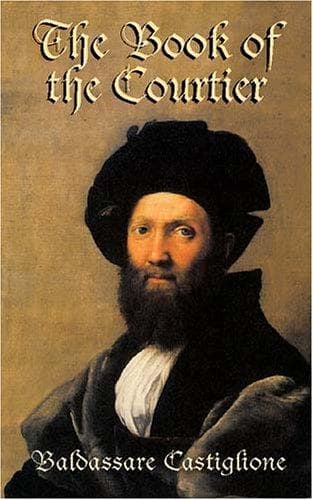
The Book of the CourtierCastiglione, Baldassarre, conte
History
The Book of the Courtier
Castiglione, Baldassarre, conte
Courtesy -- Early works to 1800; Courts and courtiers -- Early works to 1800
45.—My lord Ottaviano laughed, and said:
“My lord Magnifico, it would be more praise to the Court Lady to exalt
her until she equalled the Courtier, than to abase the Courtier until he
equalled the Court Lady; for it would be by no means forbidden the Lady
to teach the mistress also, and with her to tend towards that aim of
Courtiership which I said befits the Courtier with the prince. But you
seek more to censure the Courtier than to praise the Court Lady; hence I
too shall be allowed to take the Courtier’s part.
“To reply, then, to your objections, I declare I did not say that the
Courtier’s instruction ought to be the sole cause of making the prince
such as we would have him. For if he were not by nature inclined and
fitted to be so, all the Courtier’s care and reminders would be in vain:
just as any good husbandman also would labour in vain if he were to set
about cultivating barren sea-sand and sowing it with excellent seed,
because such barrenness is natural in that place; but when to good seed
in fertile soil, and to mildness of climate and rains suited to the
season, there is added also the diligence of human culture, very
abundant crops are always found to spring up plenteously. Nor is it on
that account true that the husbandman alone is the cause of this,
although without him all the other things would avail little or nothing.
Thus there are many princes who would be good if their minds were
rightly cultivated; and it is of these that I am speaking, not of those
who are like barren ground, and by nature so alien to good behaviour
that no training avails to lead their minds in the straight path.
46.—“And since, as we have already said, our habits are what our actions
make them, and virtue consists in action, it is not impossible or
marvellous that the Courtier should turn the prince to many virtues,
like justice, generosity, magnanimity, the practice whereof the prince
by his greatness can easily put in use and convert into habit; which the
Courtier cannot do, because he has not the means to practise them; and
thus the prince, allured to virtue by the Courtier, may become more
virtuous than the Courtier. Moreover you must know that the whetstone,
although it cuts nothing, yet makes iron sharp. Hence it seems to me
that although the Courtier instructs the prince, he need not on that
account be said to be of more dignity than the prince.
Public-domain text, read in full here on John Shaqi.
Reviews
Reviews
No reviews yet
Be the first to share your thoughts on this work.
Elsewhere in the archive
Join the Discussion
Join the discussion
Sign in to leave a comment or review.
Sign InorCreate an account