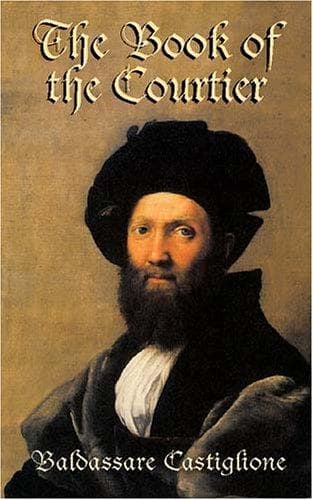
The Book of the CourtierCastiglione, Baldassarre, conte
History
The Book of the Courtier
Castiglione, Baldassarre, conte
Courtesy -- Early works to 1800; Courts and courtiers -- Early works to 1800
“My Lords, I would not have any of us, like profane and sacrilegious
men, incur God’s wrath by speaking ill of beauty, which is a sacred
thing. Therefore, to the end that my lord Morello and messer Federico
may be warned, and not lose their sight, like Stesichorus (which is a
very fitting punishment for one who scorns beauty),[476] I say that
beauty springs from God, and is like a circle of which goodness is the
centre. And hence, as there can be no circle without a centre, there can
be no beauty without goodness. Thus a wicked soul rarely inhabits a
beautiful body, and for that reason outward beauty is a true sign of
inward goodness. And this grace is impressed upon bodies, more or less,
as an index of the soul, whereby she is known outwardly, as in the case
of trees, in which the beauty of the blossom gives token of the
excellence of the fruit. The same is true in the case of human bodies,
as we see that the Physiognomists often recognize in the face the
character and sometimes the thoughts of men; and what is more, in beasts
also we discern from the aspect the quality of the mind, which is
expressed as much as possible in the body. Think how clearly we read
anger, ferocity and pride in the face of the lion, the horse, the eagle;
a pure and simple innocence in lambs and doves; cunning malice in foxes
and wolves, and so of nearly all other animals.
58.—“The ugly are therefore for the most part wicked too, and the
beautiful are good: and we may say that beauty is the pleasant, gay,
acceptable and desirable face of good, and that ugliness is the dark,
disagreeable, unpleasant and sad face of evil. And if you will consider
all things, you will find that those which are good and useful always
have a charm of beauty also.
“Look at the state of this great fabric of the world, which was made by
God for the health and preservation of every created thing. The round
firmament, adorned with so many heavenly lights, and the earth in the
centre, surrounded by the elements and sustained by its own weight; the
sun, which in its revolving illumines the whole, and in winter
approaches the lowest sign, then little by little mounts to the other
side; the moon, which derives her light from it, according as it
approaches her or withdraws from her; and the five other stars, which
separately travel the same course.[477] These things have such influence
upon one another through the linking of an order thus precisely framed,
that if they were changed for an instant, they could not hold together,
and would wreck the world; they have also such beauty and grace that
human wit cannot imagine anything more beautiful.
Public-domain text, read in full here on John Shaqi.
Reviews
Reviews
No reviews yet
Be the first to share your thoughts on this work.
Elsewhere in the archive
Join the Discussion
Join the discussion
Sign in to leave a comment or review.
Sign InorCreate an account