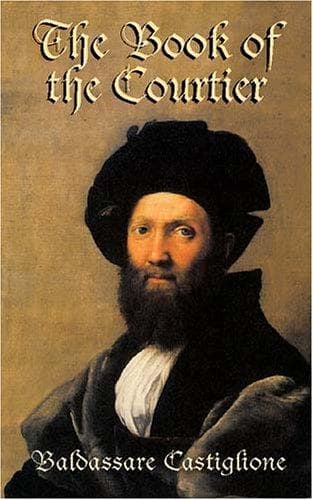
The Book of the CourtierCastiglione, Baldassarre, conte
History
The Book of the Courtier
Castiglione, Baldassarre, conte
Courtesy -- Early works to 1800; Courts and courtiers -- Early works to 1800
“Think now of the shape of man, which may be called a little world;
wherein we see every part of the body precisely composed with skill, and
not by chance; and then the whole form together so beautiful that we
could hardly decide whether more utility or more grace is given to the
human features and the rest of the body by all the members, such as the
eyes, nose, mouth, ears, arms, breast, and other parts withal. The same
can be said of all the animals. Look at the feathers of birds, the
leaves and branches of trees, which are given them by nature to preserve
their being, and yet have also very great loveliness.
“Leave nature, and come to art. What thing is so necessary in ships as
the prow, the sides, the yards, the masts, the sails, the helm, the
oars, the anchors and the cordage? Yet all these things have so much
comeliness, that it seems to him who looks upon them that they are thus
devised as much for beauty as for use. Columns and architraves support
lofty galleries and palaces, yet they are not on that account less
pleasing to the eyes of him who looks upon them, than useful to the
buildings. When men first began to build, they set that middle ridge in
their temples and houses, not in order that the buildings might have
more grace, but to the end that the water might flow off conveniently on
either side; yet to utility soon was added comeliness, so that if a
temple were built under a sky where no hail or rain falls, it would not
seem able to have any dignity or beauty without the ridge.
59.—“Much praise is therefore bestowed, not only upon other things, but
upon the world, by saying that it is beautiful. We praise when we say:
‘Beautiful sky, beautiful earth, beautiful sea, beautiful rivers,
beautiful lands, beautiful woods, trees, gardens; beautiful cities,
beautiful churches, houses, armies.’ In short, this gracious and sacred
beauty gives highest ornament to everything; and we may say that the
good and the beautiful are in a way one and the same thing, and
especially in the human body; of whose beauty I think the most immediate
cause is beauty of the soul, which (as partaker of true divine beauty)
brightens and beautifies whatever it touches, and especially if the body
wherein it dwells is not of such base material that it cannot impress
thereon its quality. Therefore beauty is the true trophy of the soul’s
victory, when with power divine she holds sway over material nature, and
by her light overcomes the darkness of the body.
Public-domain text, read in full here on John Shaqi.
Reviews
Reviews
No reviews yet
Be the first to share your thoughts on this work.
Elsewhere in the archive
Join the Discussion
Join the discussion
Sign in to leave a comment or review.
Sign InorCreate an account