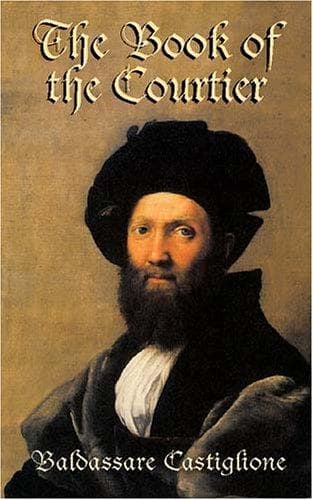
The Book of the CourtierCastiglione, Baldassarre, conte
History
The Book of the Courtier
Castiglione, Baldassarre, conte
Courtesy -- Early works to 1800; Courts and courtiers -- Early works to 1800
“I am very willing that this lady should be much more courteous to my
unyouthful Courtier, than my lord Magnifico’s is to the youthful
Courtier; and with reason, for my Courtier will desire only seemly
things, and therefore the lady can grant him all of them without blame;
while my lord Magnifico’s lady, who is not so sure of the youthful
Courtier’s modesty, ought to grant him only seemly things, and to refuse
him the unseemly. Hence my Courtier, to whom is granted what he asks, is
more happy than the other, to whom part is granted and part refused.
“And to the end that you may still better understand that rational love
is happier than sensual, I say that the same things ought sometimes to
be refused in sensual love and granted in rational love, because they
are unseemly in the one and seemly in the other. Thus, to please her
worthy lover, besides granting him pleasant smiles, familiar and secret
discourse, and leave to joke and jest with her and to touch her hand,
the lady may in reason even go so far as kissing without blame, which is
not permitted in sensual love according to my lord Magnifico’s rules.
For since the kiss is the union of body and soul, there is danger lest
the sensual lover incline more in the direction of the body than in that
of the soul; while the rational lover perceives that although the mouth
is part of the body, yet it gives issue to words, which are interpreters
of the soul, and to that inward breath which is itself even called soul.
Hence a man delights to join his mouth to that of his beloved in a kiss,
not in order to arouse any unseemly desire in him, but because he feels
that bond to be the opening of a passage between their souls, which,
being each drawn by desire for the other, pour themselves each into the
other’s body by turn, and so commingle that each has two souls, and a
single soul (thus composed of these two) rules as it were over two
bodies. Hence the kiss may be oftener said to be a joining of soul than
of body, because it has such power over the soul that it draws her to
itself and separates her from the body. On this account all chaste
lovers desire to kiss as a joining of the soul; and thus the divinely
enamoured Plato says that in kissing the soul came to his lips to escape
his body. And since the separation of the soul from things material, and
its complete union with things spiritual, may be denoted by the kiss,
Solomon, in his divine book of the Song, says: ‘Let him kiss me with the
kiss of his mouth,’ to express desire that his soul might be so
transported with divine love to the contemplation of celestial beauty,
that by joining closely therewith she might forsake the body.”
65.—Everyone gave closest heed to Bembo’s discourse; and he, having made
a little pause and seeing that no one else spoke, said:
Public-domain text, read in full here on John Shaqi.
Reviews
Reviews
No reviews yet
Be the first to share your thoughts on this work.
Elsewhere in the archive
Join the Discussion
Join the discussion
Sign in to leave a comment or review.
Sign InorCreate an account