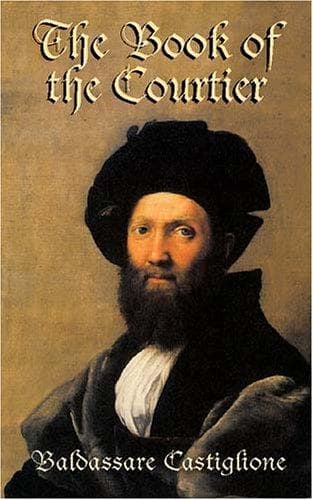
The Book of the CourtierCastiglione, Baldassarre, conte
History
The Book of the Courtier
Castiglione, Baldassarre, conte
Courtesy -- Early works to 1800; Courts and courtiers -- Early works to 1800
“Accept our souls, which are offered thee in sacrifice; burn them in
that living flame which consumes all mortal dross, to the end that,
being wholly separated from the body, they may unite with divine beauty
by a perpetual and very sweet bond, and that we, being severed from
ourselves, may, like true lovers, be able to transform ourselves into
the beloved, and rising above the earth may be admitted to the angels’
feast, where, fed on ambrosia and immortal nectar, we may at last die a
most happy and living death, as died of old those ancient fathers whose
souls thou, by the most glowing power of contemplation, didst ravish
from the body and unite with God.”
71.—Having thus far spoken, with such vehemence that he almost seemed
transported and beside himself, Bembo remained silent and motionless,
keeping his eyes towards heaven, as if wrapped in ecstasy; when my lady
Emilia, who with the others had been listening most attentively to his
discourse, took him by the border of his robe, and shaking him a little,
said:[480]
“Have a care, messer Pietro, that with these thoughts your soul, also,
does not forsake your body.”
“My Lady,” replied messer Pietro, “that would not be the first miracle
that love has wrought upon me.”
Then my lady Duchess and all the others again began urging Bembo to
continue his discourse: and everyone seemed almost to feel in his mind a
spark of that divine love which inspired the speaker, and all desired to
hear more; but Bembo added:
“My Lords, I have said that which love’s sacred phrensy dictated to me
at the moment; now that it seems to inspire me no further, I should not
know what to say: and I think love is not willing that its secrets
should be further disclosed, or that the Courtier should pass beyond
that stage which it has been pleased to have me show him; and therefore
perhaps it is not permitted to speak more of this matter.”
72.—“Verily,” said my lady Duchess, “if the unyouthful Courtier should
prove able to follow the path that you have shown him, he ought in all
reason to content himself with such great felicity, and to have no envy
of the youthful Courtier.”
Then messer Cesare Gonzaga said:
“The road which leads to this felicity seems to me so steep that I
believe it is very hard to travel.”
My lord Gaspar added:
“I believe it is hard for men to travel, but impossible for women.”
My lady Emilia laughed, and said:
“My lord Gaspar, if you return to wronging us so often, I promise you
that you will not be pardoned again.”
My lord Gaspar replied:
Public-domain text, read in full here on John Shaqi.
Reviews
Reviews
No reviews yet
Be the first to share your thoughts on this work.
Elsewhere in the archive
Join the Discussion
Join the discussion
Sign in to leave a comment or review.
Sign InorCreate an account