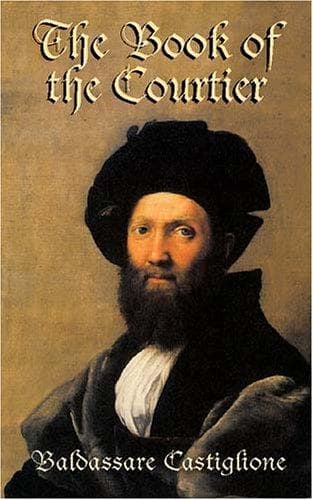
The Book of the CourtierCastiglione, Baldassarre, conte
History
The Book of the Courtier
Castiglione, Baldassarre, conte
Courtesy -- Early works to 1800; Courts and courtiers -- Early works to 1800
Baldesar’s parents were Count Cristoforo Castiglione, a
soldier-courtier, and Luigia Gonzaga, a near kinswoman of the Marquess
of Mantua. The boy studied at Milan,—learning Latin from Giorgio Merula
and Greek from Demetrios Chalcondylas, an erudite Athenian who had fled
from Byzantium about 1447, and of whom another pupil wrote: “It seems to
me that in him are figured all the wisdom, the civility and the elegance
of those ancients who are so famous and so illustrious. Merely seeing
him, you fancy you are looking on Plato; far more when you hear him
speak.”
Having spent some time at the splendid court of Ludovico Sforza at
Milan, Castiglione lost his father in 1499, and (the Sforzas being
expelled the same year) he returned to Mantua and entered the service of
his natural lord, the Marquess Gianfrancesco Gonzaga; he accompanied
this prince to Milan to witness the entry of Louis XII of France, and
afterwards on an expedition to aid the French in their vain effort to
hold the kingdom of Naples against the Aragonese. When Gonzaga abandoned
the French cause (after being defeated by Ferdinand the Catholic’s
“Great Captain,” Consalvo de Cordova, near the Garigliano in 1503),
Castiglione obtained leave to go to Rome, and there met Duke Guidobaldo
di Montefeltro, who had come to pay homage to the newly elected Pope
Julius II. He entered the duke’s service, and soon became one of the
brightest ornaments of that brilliant company of statesmen, prelates,
scholars, poets, wits and ladies, known as the Court of Urbino.
In 1504 he took part, under Duke Guidobaldo, in the papal siege of
Cesena against the Venetians. The next year he attended the duke on a
diplomatic visit to Rome. In 1506 he was sent to the court of Henry VII
of England to receive the insignia of the Order of the Garter on the
duke’s behalf. As appears from a letter to his mother, he returned to
Urbino as early as 5 March 1507, notwithstanding his mention of himself
in The Courtier as still absent in England at the date (8-11 March) of
the dialogues he professes to report at second hand. In the same year he
was sent on a mission to Louis XII at Milan.
Public-domain text, read in full here on John Shaqi.
Reviews
Reviews
No reviews yet
Be the first to share your thoughts on this work.
Elsewhere in the archive
Join the Discussion
Join the discussion
Sign in to leave a comment or review.
Sign InorCreate an account