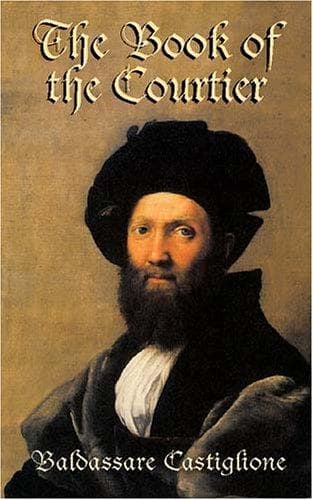
The Book of the CourtierCastiglione, Baldassarre, conte
History
The Book of the Courtier
Castiglione, Baldassarre, conte
Courtesy -- Early works to 1800; Courts and courtiers -- Early works to 1800
On Guidobaldo’s death in 1508, Castiglione continued in the service of
the new duke, Francesco Maria della Rovere (“my lord Prefect” of THE
COURTIER), who appointed him governor of Gubbio. In the following year
he served in his master’s campaign against the Venetians, and contracted
a dangerous illness, during which he was tenderly nursed by the dowager
duchess, Elisabetta Gonzaga. In 1511 he accompanied the duke to Rome on
the occasion of the latter’s trial for the murder of Cardinal Alidosi,
and was active in Francesco Maria’s successful defence. In 1513 the duke
created him Count of Novillara and gave him an estate of that name,
which however he soon lost through the Medici usurpation of the duchy,
and never regained. At the death of Julius II, Castiglione was
ambassador to the sacred college, and continued in that office during
nearly the whole of Leo X's pontificate. His numerous letters show the
variety and importance of the diplomatic business in which he was
engaged.
Several plans for his marriage came to nothing, and on one occasion,
when the lady’s father hesitated, the suitor broke off negotiations,
saying: “The wife that I am to take, be she who she may, I desire that
she should be given to me with as good will as I take her withal,—yea,
if she were the daughter of a king.”
Pope Leo having in 1516 basely deprived Francesco Maria of the Duchy of
Urbino, Castiglione accepted an invitation to Mantua and there married
Ippolita, daughter of Count Guido Torello di Montechiarugolo and
Francesca Bentivoglio, a daughter of the former ruler of Bologna. This
union proved exceptionally happy and was blessed by three children: a
son Camillo, a daughter Anna, and a second daughter Ippolita, at whose
birth the young mother lost her life in 1520. His son attained the age
of eighty years, and is said to have been the true embodiment of the
qualities described in THE COURTIER.
Castiglione resided alternately at Mantua and at Rome, where he served
as Mantuan ambassador, and where his learning, wit, taste, gentle
disposition and integrity earned for him an almost unique eminence at
the papal court.
In 1524 he was sent by Pope Clement VII as ambassador to the Emperor
Charles V (who was waging war against the French in Italy), but while
his counsel and high qualities were appreciated, he was too honest a man
to cope with the tortuous politics of the time, and proved unable to
avert the capture and sack of Rome (1527) or the imprisonment of the
pope. These catastrophes, together with a malicious and easily disproved
charge of treason brought against him, preyed upon his health, and
despite the many honours conferred upon him by Charles, he failed to
rally, and finally died at Toledo, 7 February 1529, without again seeing
his native land. His body was afterwards brought to Italy and buried in
the church of the Madonna delle Grazie near Mantua, where his tomb was
erected from designs by his young friend Giulio Romano.
Public-domain text, read in full here on John Shaqi.
Reviews
Reviews
No reviews yet
Be the first to share your thoughts on this work.
Elsewhere in the archive
Join the Discussion
Join the discussion
Sign in to leave a comment or review.
Sign InorCreate an account