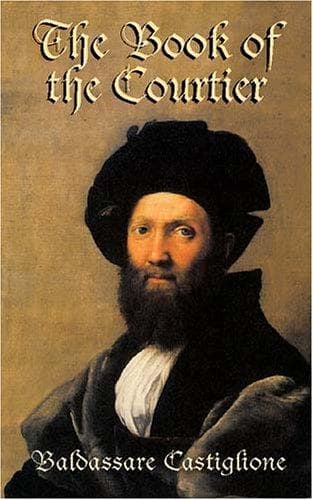
The Book of the CourtierCastiglione, Baldassarre, conte
History
The Book of the Courtier
Castiglione, Baldassarre, conte
Courtesy -- Early works to 1800; Courts and courtiers -- Early works to 1800
In 1489 Guidobaldo married Elisabetta Gonzaga, a sister of the Marquess
of Mantua. All hopes, however, of an heir were soon abandoned,
apparently owing to the young duke’s physical infirmities, which were
increased by over exercise and in time unfitted him for all active
occupations. Nevertheless he was able to take part in the vain
resistance to Charles VIII's invasion of Italy, and later in the
expulsion of the French from the kingdom of Naples. While fighting in
the service of Pope Alexander VI in 1497, he was taken prisoner and
forced to pay a ransom of 30,000 ducats, a sum then equivalent to about
twice that number of modern pounds sterling, and raised only at the
sacrifice of his duchess’s jewels. In 1501 he aided rather than opposed
Louis XII's invasion of Naples.
In 1502 the pope’s son Cesare Borgia treacherously seized the Duchy of
Urbino. To spare his people bloodshed and ruin, Guidobaldo fled in
disguise to his brother-in-law at Mantua, and after a vain appeal to
Louis XII, found an honourable asylum at Venice. In the same year he
regained his dominions for a short time, but was again forced to take
flight. On the death of Alexander VI (August 1503), Cesare’s power
crumbled, Guidobaldo easily recovered his duchy, and his position was
soon assured by the election of Julius II, who was not only his personal
friend, but also the brother of his sister Giovanna’s husband. In 1504
he formally adopted as his heir this sister’s son, Francesco Maria della
Rovere, and (as we have seen) took into his service the future author of
THE COURTIER. His learning, amiability and munificence attracted choice
spirits to his court, which came to be regarded as the first in Italy.
Pope Julius was splendidly entertained there on his way both to and from
his Bologna campaign, and the Courtier dialogues are represented as
taking place immediately after his departure for Rome in March 1507.
Long an invalid, Guidobaldo became more and more a martyr to his gout,
which was aggravated by a season of exceptional drought and cold and
brought him final relief from suffering in April 1508. His fame rests,
not upon his military and political achievements, but upon the beauty of
his character, the variety of his intellectual accomplishments, the
patience with which he endured reverses, illness and forced inaction,
and upon the culture and refinement that characterized his court.
Note 3 page 1. FRANCESCO MARIA DELLA ROVERE, Duke of Urbino, (born 1490;
died 1538), was the son of Giovanni della Rovere and Duke Guidobaldo’s
sister Giovanna di Montefeltro. Giovanni was a nephew of Pope Sixtus IV
(who had made him Prefect of Rome), and a younger brother of Cardinal
Giuliano della Rovere, afterwards Pope Julius II.
Public-domain text, read in full here on John Shaqi.
Reviews
Reviews
No reviews yet
Be the first to share your thoughts on this work.
Elsewhere in the archive
Join the Discussion
Join the discussion
Sign in to leave a comment or review.
Sign InorCreate an account