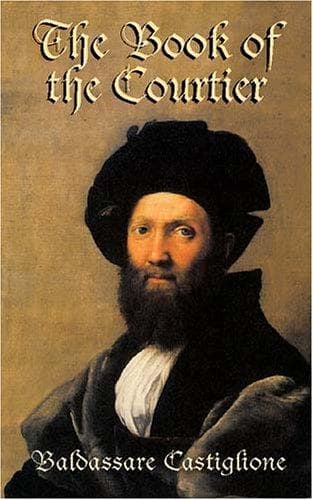
The Book of the CourtierCastiglione, Baldassarre, conte
History
The Book of the Courtier
Castiglione, Baldassarre, conte
Courtesy -- Early works to 1800; Courts and courtiers -- Early works to 1800
On his father’s death in 1501, Francesco was brought to the court of his
uncle Guidobaldo, who secured for him a renewal of the Prefecture and
superintended his education. In THE COURTIER he appears as “my lord
Prefect.” During the Borgian usurpation of the duchy, he found refuge at
the court of Louis XII; and soon after the fall of the Borgias and his
uncle Julius II's accession, he was adopted as Guidobaldo’s heir, while
through the mediation of Castiglione a marriage was arranged for him
with Eleanora, daughter to the Marquess of Mantua and niece to the
Duchess of Urbino. He now resided chiefly with his uncle, acquainting
himself with his future subjects and duties. Although he possessed many
of the good qualities ascribed to him in THE COURTIER, his temper was
ungovernable, and before reaching the age of eighteen he slew one of the
members of the court, who was accused of seducing his sister.
Having become duke in 1508, he was married on Christmas Eve of that
year. In the following spring he commanded the papal forces in the
League of Cambray, and despite the obstacles put in his way by his
colleague Cardinal Alidosi (see note 268), he soon reduced the Romagna
towns, the recovery of which from Venice was Julius II's chief object in
forming the league. In a later campaign against the French, Bologna was
lost to the Church (1511) through the treachery of Alidosi, who craftily
contrived to have the blame fall upon Francesco, and was murdered by the
latter at Ravenna. After a long trial before six cardinals, in which
ample proof of the dead man’s treason was presented, and an eloquent
appeal made by Beroaldo (see note 235),—the young duke was acquitted and
restored to the pope’s favour.
Although both Francesco and his predecessor had generously befriended
the Medici during their exile from Florence (1494-1512), Leo X (Giovanni
de' Medici) seized his duchy in 1516, to bestow it on a nephew, Lorenzo
de' Medici. It is needless to speak here of Francesco’s restoration in
1521, of his failure to relieve Pope Clement VII when Rome was sacked in
1527, or of his later life.
While small in person, Francesco was active and well formed. His manners
were gentle and his character forgiving, in spite of his fiery temper.
Strict in religious observances and an enemy to blasphemous language, he
was also creditably intolerant of those outrages upon womanly honour
with which war was then fraught. He was famous chiefly as a soldier, and
by so competent a judge as the Emperor Charles V was regarded as master
of the military science of his day.
Public-domain text, read in full here on John Shaqi.
Reviews
Reviews
No reviews yet
Be the first to share your thoughts on this work.
Elsewhere in the archive
Join the Discussion
Join the discussion
Sign in to leave a comment or review.
Sign InorCreate an account