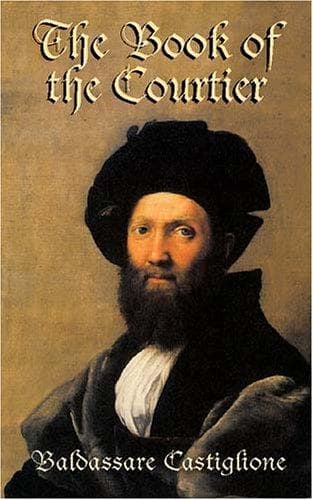
The Book of the CourtierCastiglione, Baldassarre, conte
History
The Book of the Courtier
Castiglione, Baldassarre, conte
Courtesy -- Early works to 1800; Courts and courtiers -- Early works to 1800
Note 8 page 8. ALFONSO ARIOSTO, (died 1526), was a cousin of the poet
Ludovico. Little more seems to be known of him than that his father’s
name was Bonifazio, that he was a gentle cavalier and brave soldier in
the service of the Este family, and that he was a friend of Castiglione
and of Bembo. His name appears at the head of each of the four dialogues
composing THE COURTIER, and they purport to have been written at his
suggestion. Señor A. M. Fabié, in his notes to the 1873 reprint of
Boscan’s translation, affirms that Alfonso Ariosto had nothing to do
with the poet Ludovico, belonged to a noble Bolognese family, and
enjoyed much favour at the court of Francis I of France.
Note 9 page 9. GIULIANO DE' MEDICI, (born 1478; died 1516), was the
third son of Lorenzo the Magnificent and Clarice Orsini. His education
seems to have been for a time entrusted to the famous scholar-poet
Poliziano (see note 105). During his family’s exile from Florence
(1494-1512), he resided much at the court of Urbino, where he was known
as “the Magnifico Giuliano,” and where one wing of the great palace was
reserved to his use and is still called by his name. He became the
father of a boy afterwards known as Cardinal Ippolito de' Medici,—the
original of Titian’s fine portrait in the Pitti Gallery. On the
restoration of the Medici, Giuliano was placed at the head of affairs in
his native city and succeeded in winning the good will of the
Florentines, but his gentle disposition and love of ease thwarted other
ambitious projects formed for his advancement by his brother Leo X, and
he was too grateful to the dukes of Urbino for their hospitality to
accept the pope’s intended appropriation of their duchy for his benefit.
In 1515 he married Filiberta of Savoy and was created Duke of Nemours by
her nephew Francis I of France. In the same year he was appointed
Captain General of the Church, but failing health prevented his actual
service, and he soon died of fever at Florence, not without suspicion of
poison at the hands of his nephew Lorenzo.
Several of his sonnets have survived, and are said to show no mean
poetic faculty. Apart, however, from his appearance as an interlocutor
in THE COURTIER and in Bembo’s _Prose_, his memory is best preserved by
Michelangelo’s famous tomb at Florence.
[Illustration:
VITTORIA COLONNA
MARCHIONESS OF PESCARA
1490-1547
]
Much enlarged from a cast, kindly furnished by M. Pierre Valton, of an
anonymous medal in his collection at Paris.
Public-domain text, read in full here on John Shaqi.
Reviews
Reviews
No reviews yet
Be the first to share your thoughts on this work.
Elsewhere in the archive
Join the Discussion
Join the discussion
Sign in to leave a comment or review.
Sign InorCreate an account