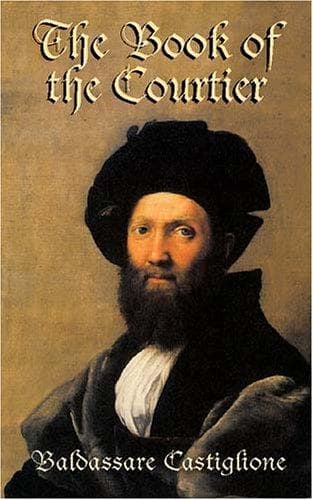
The Book of the CourtierCastiglione, Baldassarre, conte
History
The Book of the Courtier
Castiglione, Baldassarre, conte
Courtesy -- Early works to 1800; Courts and courtiers -- Early works to 1800
Note 10 page 2. “MESSER BERNARDO” (DOVIZI), better known by the name of
his birthplace BIBBIENA, (born 1470; died 1520), was of humble
parentage. His elder brother Pietro was secretary to Lorenzo de' Medici,
and secured his admission to the Magnifico’s household, where he shared
the education of the young Giovanni and became a devoted friend of that
future pope. Following the Medici into exile, he travelled about Europe
with Giovanni and attended Giuliano to Urbino, where he received the
warm welcome always accorded there to such as combined learning with
courtly manners. By the Duke of Urbino he seems to have been so
commended to the favour of Julius II, that he was able to aid
Michelangelo in securing part payment for the Sistine Chapel frescoes,
of which payment, however, he accepted five per cent. as a gift from the
painter. At the death of Julius, he was secretary to his friend Cardinal
Giovanni de' Medici, and in that capacity had access to the conclave,
where his adroitness was largely helpful in effecting his patron’s
election as pope. Leo at once made him Cardinal of Santa Maria in
Portico and loaded him with lucrative offices. During the Medicean
usurpation of the Duchy of Urbino, he showed no gratitude for the
kindness enjoyed by him at that court. He became very rich, and was a
liberal patron of authors and artists. Raphael devised to him the house
of the architect Bramante, which the painter had bought for a sum
equivalent to about £6,000, and which was afterwards demolished in
extending the piazza in front of St. Peter’s.
Besides a large number of his letters, for the most part unpublished, we
have his play, _Calandra_, founded upon the _Menæchmi_ of Plautus and
once esteemed as the earliest Italian prose comedy.
Although he was bald, and although his friend Raphael’s portrait hardly
justifies the epithet, he was known as the “_Bel Bernardo_.” A
contemporary MS. in the Vatican describes him as “a facetious character,
with no mean powers of ridicule, and much tact in promoting jocular
conversation by his wit and well-timed jests. He was a great favourite
with certain cardinals, whose chief pursuit was pleasure and the chase,
for he thoroughly knew all their habits and fancies, and was even aware
of whatever vicious propensities they had. He likewise possessed a
singular pliancy for flattery, and for obsequiously accommodating
himself to their whims, stooping patiently to be the butt of insulting
and abusive jokes, and shrinking from nothing that could render him
acceptable to them. He also had much readiness in council, and was
perfectly able seasonably to qualify his wit with wisdom, or to
dissemble with singular cunning.” On the other hand, Bembo wrote of him
to their friend Federico Fregoso: “The days seem years until I see him,
and enjoy the pleasing society, the charming conversation, the wit, the
jests, the features and the affection of that man.”
Public-domain text, read in full here on John Shaqi.
Reviews
Reviews
No reviews yet
Be the first to share your thoughts on this work.
Elsewhere in the archive
Join the Discussion
Join the discussion
Sign in to leave a comment or review.
Sign InorCreate an account