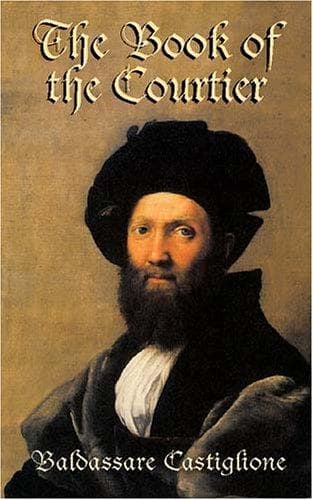
The Book of the CourtierCastiglione, Baldassarre, conte
History
The Book of the Courtier
Castiglione, Baldassarre, conte
Courtesy -- Early works to 1800; Courts and courtiers -- Early works to 1800
Note 11 page 2. OTTAVIANO FREGOSO, (died 1524), belonged to a noble
Genoese family that had long distinguished itself in public service and
had furnished several doges to the Republic. His parents were Agostino
Fregoso and Gentile di Montefeltro, a half-sister of Duke Guidobaldo.
Driven from Genoa as early as 1497, he entered his uncle’s court at
Urbino and rendered important military services, especially during the
struggle with Cesare Borgia, in which he gallantly defended the fortress
of San Leo (see note 275), and was rewarded with the lordship of Santa
Agata in the Apennines. In 1506 he commanded the papal forces for the
recovery of Bologna, and later in the League of Cambray against Venice.
In 1513 he succeeded in putting an end to French domination in Genoa,
was elected doge, and ruled so beneficently for two years that when
Francis I regained the city, Fregoso was continued as governor. In 1522
Genoa was captured and sacked by Spanish and German troops, and Fregoso
given over to the Marquess of Pescara, treated harshly (despite
Castiglione’s intercession on his behalf), and carried to Ischia, where
he died.
Several stories of his absent-mindedness are narrated by Dennistoun, and
one illustrates the freedom of intercourse at the court of Urbino. His
uncle Guidobaldo appearing one day in a beautiful violet satin jerkin,
Ottaviano exclaimed: “My lord Duke, you really are _the_ handsome
Signor!” and then, on being reproved for flattery, he replied: “I did
not mean that you are a man of worth, though I pronounced you a fine man
and a handsome nobleman.”
Note 12 page 2. “MY LADY DUCHESS,” ELISABETTA GONZAGA, (born 1471; died
1526), was the second daughter of the Marquess Federico Gonzaga of
Mantua and Margarita of Bavaria. She married Duke Guidobaldo in 1489. In
1502 she reluctantly attended the festivities for the marriage, at
Ferrara, of Lucrezia Borgia to Alfonso d'Este, and some of her costumes
are thus described by an eye-witness: On entering Ferrara, she rode a
black mule caparisoned in black velvet embroidered with woven gold, and
wore a mantle of black velvet strewn with triangles of beaten gold, a
string of pearls about her neck, and a cap of gold; another day indoors
she wore a mantle of brown velvet slashed, and caught up with chains of
massive gold; another day a gown of black velvet striped with gold, with
a jewelled necklace and diadem; and still another day, a black velvet
robe embroidered with gold ciphers.
Public-domain text, read in full here on John Shaqi.
Reviews
Reviews
No reviews yet
Be the first to share your thoughts on this work.
Elsewhere in the archive
Join the Discussion
Join the discussion
Sign in to leave a comment or review.
Sign InorCreate an account